

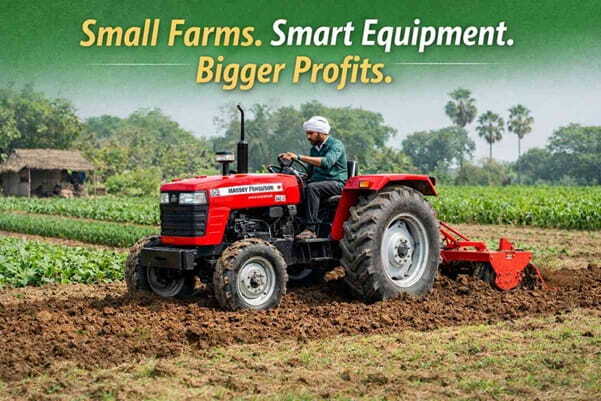
Featured Image Caption: Farmer Pluging Field with Tractor
Jump to read...
Tiny farms are a big deal in Indian agriculture. The majority of farmers work on small tracts. But with the right equipment and the judicious use of labor, even a small farm can deliver big yields. Productivity is not always about more land. This can include better planning and improved equipment.
These days, farm machinery is not reserved only for large landowners. New technologies are being developed for small and medium farmers as well. By selecting the right tools, time can be saved and labour costs reduced while productivity of the crop increased.
Let’s learn how small farms can still produce big savings.
Why Equipment Matters on Small Farms
On a small farm, every acre matters. Every mistake can affect income. Manual work takes time. It also reduces efficiency at peak times such as sowing and harvesting.
Using proper machinery helps in:
- Faster land preparation
- Uniform sowing and planting
- Better weed control
- Timely harvesting
- Lower labour dependency
The more that work is performed in time, the better crops grow. Tactically farmed turns out to also usually mean more profitable market prices.
Step 1: Understand Your Farm Needs
Farmers should have their farms assessed before purchasing any machinery.
Ask simple questions:
- What crops do I grow?
- How many acres do I have under cultivation?
- Is my ground hard, soft or a mix?
- For ploughing, spraying, hauling or everything?
For instance, a farmer cultivating 3–5 acres of vegetables do not require a very high horsepower tractor. A small, fuel-efficient tractor should suffice.
Clear planning avoids overspending.
Step 2: Choosing the Right Tractor
The tractor is the nucleus of farm mechanisation. For small farms, the right tractor:
- Fuel-efficient
- Easy to maintain
- Suitable for multiple implements
- Affordable
- Comfortable for long working hours
Its toughness and great performance make farmers who visit us choose Massey Ferguson. These tractors are known for
- Reliable engines
- Good hydraulic lifting capacity
- Smooth gear shifting
- Strong resale value
What will a mid-range or compact Massey Ferguson tractor be able to do?
- Rotavator work
- Cultivator operations
- Seed drilling
- Trailer transport
That makes it a viable choice for small pieces of land.
Step 3: Focus on Multi-Purpose Implements
Small farmers could do better by putting that money into multi-purpose implements rather than lots of machines.
Important implements include:
- Rotavator
- Helps in soil preparation
- Saves time versus the double plough traditionally used
- Improves soil mixing
- Cultivator
- Removes weeds
- Breaks soil clods
- Prepares seedbed
- Seed Drill
- Ensures uniform seed spacing
- Saves seed cost
- Improves crop growth
- Sprayer
- Protects crops from pests
- Ensures even chemical application
When such implements are combined with Massey Ferguson tractor to which they are generally compatible and designed, a farmer can then perform several operations without the use of external machines.
Step 4: Consider Fuel Efficiency and Maintenance
Dickson said, For the small farm machine size is less important than operating cost.”
Before purchasing equipment, check:
- Fuel consumption per hour
- Service interval
- Availability of spare parts
- Local service centers
A tractor that burns less fuel, requires fewer repairs is cheaper over the long term. Routine maintenance also extends machine life.
Farmers should always:
- Check engine oil regularly
- Clean air filters
- Inspect hydraulic systems
- Avoid overloading
It is up to reasonable conservation which results in profit.
Step 5: Think About Future Growth
Even little farmers should have a long-range plan. Three acres could be on its way to becoming 6 acres. So, equipment ought to permit some stretch.
If the work is small and not excessive, you can get it done with a tractor like Massey Ferguson. It is compatible with a number of implements, allowing farmers to rotate crops.
Future-proof equipment provides assurance and stability.
Step 6: Use Technology Smartly
Farming not just machines in age of automation It’s also about smart decisions.
Measures for enhancing small farmers’ productivity include:
- Using soil testing before sowing
- Following crop rotation
- Monitoring weather forecasts
- Using efficient irrigation systems
Mobile apps, even simple ones, could be used to track market prices and weather updates.
Technology with the right tool ‘means increased productivity Learn more for your industry When you pair technology with the appropriate equipment, productivity naturally rises.
Advantages of Proper Equipment Selection
What Small Farms Are Able to See When small farms make prudent financial decisions, they can see:
- An increase in crop yield
- Lower labor expenses
- Improved time management
- Enhanced quality of soil
- An increase in yearly income
Despite having fewer acres, small farms can compete on efficiency.
Common Errors to Steer Clear of
These errors are common among farmers:
- Purchasing large tractors
- Neglecting upkeep
- Prioritizing cost over quality
Not verifying compatibility with the implementation
Put long-term value first instead. A reliable, matched machine is preferable to a stronger but less appropriate one.
Conclusion
Small farms have huge potential. With a bit of care and investment in the proper equipment, they can get impressive results.
It is not size but smart investment that matters. The use of a reliable machine like Massey Ferguson tractor (with appropriate implements and good operation or maintenance conditions) can convert daily farming routine into an efficient, economic activity.
By Nishigandha Thopate
who is an independent content writer with a strong interest in agriculture and tractor-related topics. She creates informative and practical content for farmers and industry readers through KhetiGaadi, focusing on modern farming, farm machinery, and agricultural trends.
Member since March, 2026
View all the articles of Nishigandha Thopate.










Leave a Reply