

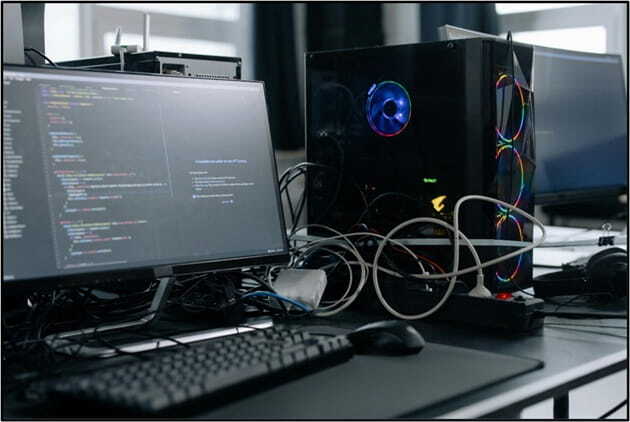
Featured Image Caption: Workstation While Working on the Webpage
Jump to read...
Most healthcare software now goes beyond simple record keeping. In 2026, digital health platforms manage and interact with patients’ mobile app data through cloud systems, AI tools, and integrated devices. Therefore, developing software with the consideration of HIPAA compliance is no longer an option, but a necessity.
Any software that generates, stores, and transmits Protected Health Information (PHI) is subject to HIPAA regulations. Noncompliance leads to hefty penalties and lawsuits, and loss of the trust of the people. This guide will explore what HIPAA compliance software development is, why it is important, and how to create compliant health care software in 2026.
What is HIPAA Compliance?
HIPAA, or the Health Insurance Portability and Accountability Act, is legislation in the United States that deals with the protection of patients’ medical-related privacy. This pertains to the hospitals and medical facilities, the insurance companies, and any related tech companies that come in contact with the Protected Health Information (PHI).
When patient data is involved, HIPAA compliance must be maintained to ensure that data is properly sealed from unauthorized access and breaches, only used for stated and intended purposes, properly maintained, and all requirements for documents and data transmission, storage, and audit are met.
From a HIPAA compliance software development perspective, handling the HIPAA compliance will depend largely on how the systems are engineered, coded, and ye are hosted and how they are maintained.
What are the Key HIPAA Rules Developers Must Follow
Here are some key rules every developer should follow for HIPAA compliance software development:
HIPAA Privacy Rule
The Privacy Rule under HIPAA outlines the scope of collection, access, usage, and dissemination of Protected Health Information (PHI). This rule ensures patient information is utilized only in instances that warrant it and are legitimately authorized. Within the context of software development, this rule demands access privileges that permit only the administrator to view and edit sensitive information assigned to their respective roles. HIPAA-compliant systems are also required to facilitate the access of patients to their rights, which include the right to view their medical records, the right to request changes to their medical records, and the right to know how their information is utilized.
HIPAA Security Rule
The HIPAA Security Rule is designed to be the electronic shield of the PHI (ePHI), as it outlines the administrative, physical, and technical sides of protections needed. From a software development position, this encompasses the use of encryption for data both in transit and at rest, as well as authenticating the data through secure roles, access, and automatic time-out features that shut down the session. Lastly, there is the logging of audits, and the continuous evaluation of the rule’s policies, as well as the complete monitoring of the legal rights to use to prevent access and loss of data.
HIPAA Breach Notification Rule
The HIPAA Breach Notification Rule deals with aftermath scenarios where there is a compromise of the PHI due to a security breach and/or unauthorized access. The organizations involved in the breach have to evaluate the breach, which entails figuring out who is impacted, and subsequently issuing notifications to the patients concerned and the regulatory bodies within a given timeframe.
What are the Core Features of HIPAA-Compliant Software
To meet HIPAA standards, healthcare software must include the following features:
Secure Authentication and Access Control
Users see only the information they are permitted to view through role-based access. An additional security layer is provided by multi-factor authentication.
Data Encryption
All PHI is required to be encrypted, both at rest and during transit. This safeguards the information, even if the systems are compromised.
Audit Logs and Monitoring
HIPAA mandates the logging of details concerning who accessed information, at what time, and what operations were performed. The logs also have to be secure from any alterations.
Secure Data Backup and Recovery
Automated backups and disaster recovery strategies are critical. The loss of information can be just as dangerous as a data breach.
Session Timeouts and Auto Logoff
To reduce the risk of unauthorized access, idle sessions should be set to close automatically.
Why HIPAA Compliance Software Development Matters in 2026
Healthcare technology has evolved rapidly. In 2026, software systems commonly use:
- Cloud infrastructure
- AI-driven diagnostics
- Telemedicine platforms
- Wearable device integrations
- Remote patient monitoring
With these advancements, data exposure risks have increased. Cyberattacks targeting healthcare systems are more frequent and more damaging than ever.
HIPAA compliance software development helps organizations:
Protect sensitive patient data, avoid regulatory penalties, build trust with users and healthcare partners, and scale safely in regulated markets like the US.
What are the Common HIPAA Compliance Mistakes to Avoid
Many software projects fail compliance due to avoidable errors, such as:
Assuming Encryption Alone is Enough
Many companies believe encrypting patient data means their software is HIPAA compliant. This is incorrect because while encryption is good, HIPAA compliance also considers access control, monitoring, authentication, and data handling. Encrypted data can still be compromised and misused when there is no control over who can access which data.
Ignoring Audit Logging
Not doing audit log tracking is not just a violation of HIPAA; it also makes it impossible to answer who accessed patient data, when, and what they did when patient data was accessed. This makes it very hard to identify any unusual activities, respond to problems, or demonstrate compliance when audits come around. Organizations may not realize a breach occurred because they’re not logging, and it may go unnoticed.
Poor Access Control Implementation
Access control is a big part of HIPAA compliance, in that it is there to make sure employees can’t see data that is not necessary for their responsibilities, and data is kept secure. This is a big problem when systems don’t have distinct roles or when multiple people log in using the same credentials.
Lack of Employee Security Training
Even the most secure software can fail if employees are not trained to handle patient data responsibly. Human error remains one of the leading causes of HIPAA violations, including phishing attacks, weak passwords, and accidental data sharing. HIPAA requires organizations to train employees on data security practices and compliance responsibilities.
Conclusion
The prediction of HIPAA compliance software development in 2026 will need to be creative and responsible. The more advanced the software in the healthcare industry becomes, the greater the need for strong protection of data to guard against breaches.
When developing HIPAA-compliant software, one must create safe and secure systems and maintain compliance throughout the software’s entire lifetime. For the organizations that want to enter or grow into the healthcare field, compliance means more than just evading fines. It means doing right by the patients and building trust and a good name for the organization.
By Sarah Lewis
who is an IT Project Manager at Binmile Technologies, a custom software development company in the USA. She has more than 10 years of experience in the IT sector. She enjoys writing technical articles in her free time.
Member since January, 2026
View all the articles of Sarah Lewis.





Leave a Reply