

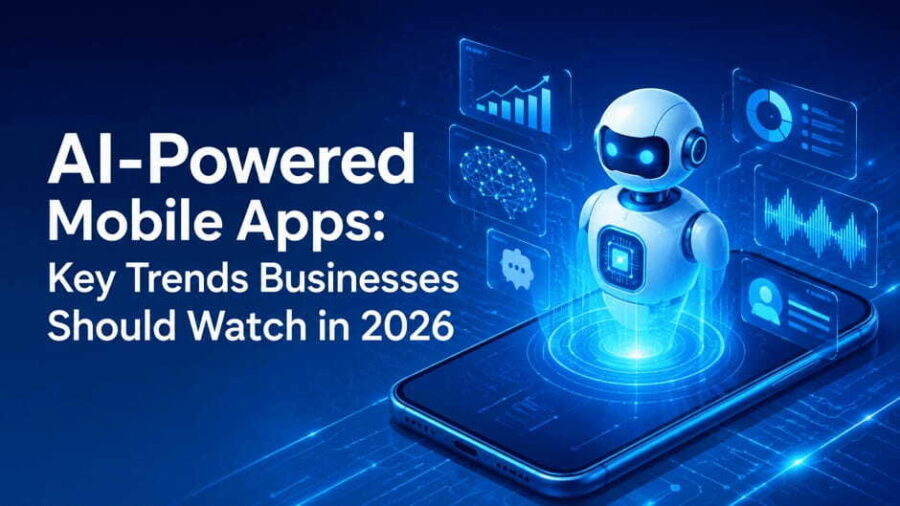
Featured Image Caption: Key AI-powered mobile app trends businesses need to watch heading into 2026.
Jump to read...
In the mobile application landscape, artificial intelligence is transforming the landscape. It goes beyond chatbots and recommendation engines to impact the entire product lifecycle. Businesses are beginning to look at applications that support contextual understanding, personalization, automation, multi-modal processing, and real-time decision making.
The rise of AI apps is evident from Sensor Tower’s research, which forecasts global generative AI app time spent to reach 36 billion hours in the first half (H1) of 2026, compared to 17.2 billion hours in H1 2025. Sensor Tower also estimates AI app in-app purchase revenue to exceed $4 billion during H1 2026.
For businesses, these trends open up new opportunities for products or services that are looking to innovate or update their offerings. Understanding the direction of AI apps can help businesses make better technology and product choices.
Below are 10 trends that can help businesses navigate the space of AI apps in 2026.
Generative AI Is Embedded Into Apps
The excitement around generative AI has led to businesses experimenting with generative AI as an application feature. For many products, this means that the core application workflows now involve generative AI.
Depending on the application space, businesses can use generative AI to implement:
- Text and content generation,
- Summarization,
- Report generation,
- Personalization,
- Conversational search,
- Customer support,
- Image and document analysis,
- Intelligent writing assistance,
- among other functions.
The key difference here is that businesses are embedding AI into their applications as opposed to only using chatbots and recommendation engines. An application may allow users to ask questions in natural language rather than use drop-down menus and checkboxes. In context, a management application may allow users to ask questions about their sales performance, while an educational application could use summarization and personalization to help students learn.
AI Agents Enable Apps to Execute Actions
AI agents are a hot topic in 2026. Unlike traditional applications that respond to requests, AI agents are designed to execute higher-level tasks that require intention, planning, and access to relevant systems.
For mobile applications, this could transform the way users interact with apps. Instead of “show me available flight options,” an AI agent may execute “find the best option for my flights.”
Users retain control of the agent, but the execution of the request is automated. This has implications for most application spaces, including e-commerce, travel, finance, healthcare, logistics, customer support, and productivity.
It is worth noting that many businesses are already testing AI agents to perform tasks such as shopping and interacting with other applications.
On-Device AI Offers Better Privacy and Performance
While cloud AI will continue to be critical, businesses are looking at on-device AI for some workflows. On-device AI allows applications to perform specific tasks on the user’s device rather than over the cloud.
On-device AI can be faster and more efficient while offering better privacy and offline access.
These advantages make on-device AI attractive, especially for applications that handle sensitive data sets. It is important to note that on-device AI is not always better – computationally intensive tasks are better suited for cloud AI.
The future of mobile application AI is most likely a combination of on-device and cloud AI, with businesses using whichever is more appropriate for a given task. Sensor Tower’s analysis of 2026 mobile AI trends confirms that both approaches are being pursued.
Multimodal AI Makes Apps More Natural
Most smartphones and other mobile devices have a variety of sensors. Modern users also interact with smart devices using voice, cameras, touchscreens, GPS, and other methods.
Multimodal AI allows applications to take advantage of the different ways users engage with mobile devices. A user could, for instance, take a picture with their phone’s camera and then ask the application to analyze the image. Alternatively, a user could speak their request instead of typing it or upload a document and ask the application to find specific information. Multimodal AI can also combine different input methods, particularly voice, image capture, and text, within one application space.
It is especially beneficial to have multimodal applications in application spaces that require capturing images or video rather than text. As multimodal AI develops, businesses can also take advantage of more natural UI/UX to create smarter applications.
Personalization Is More Powerful With AI
Personalization is common in many applications, but AI enables better levels of personalization. In many cases, AI can analyze a larger set of signals to determine a user’s intent and tailor suggestions accordingly. For instance, a fitness app could combine a user’s preferences, behavior, activity level, and even feedback to offer better recommendations. An e-commerce application could use similar strategies to deliver more relevant suggestions.
Personalization is not just about showing different recommendations to different users. It is also about making the interaction more relevant to each user. It is worth noting that businesses should always be transparent about how user data is used for personalization.
Search Gets Smarter With AI
Many applications use a search function that relies on keywords. AI can empower applications with more natural search capabilities that understand intent and context.
Users can, for instance, type out a request rather than use keywords. An e-commerce application would typically use search terms such as “running shoes men’s size 10,” but an AI-driven app would handle a request such as “I need lightweight running shoes for long-distance running on a budget” to deliver better results.
The same approach works in other application spaces, including travel, finance, healthcare, education, and enterprise software. Instead of searching for specific terms, users can ask for what they want to achieve using natural language. AI-powered search can also help reduce the number of screens that users navigate before they find what they are looking for, thus improving the overall application experience.
AI Makes Apps Safer
AI can improve the security of mobile applications in several ways. First, it can detect unusual patterns that may indicate malicious activity or compromise. AI can also support more robust account security, reducing the risk of unauthorized access. Some of the key areas include:
- Fraud detection,
- Suspicious login activity,
- Account takeover,
- Anomaly detection,
- Transaction scanning,
- Threat detection,
- among others.
In the context of finance and e-commerce applications, AI could be used to scan transactions and flag suspicious ones. It is important to note that AI can improve application security, but it should not be the sole security measure. Reliable mobile applications use a combination of AI and traditional security measures such as strong authentication and data encryption.
Customer Support Is Improved by AI
Customer-facing applications typically have a customer support component. Many businesses are now experimenting with AI assistants to handle customer support requests. AI can be used to respond to frequently asked questions, summarize customer conversations, retrieve relevant information, and guide users through the support process.
The next step in this space is to enable AI assistants to take action with the user’s permission. This includes enabling the assistant to update settings, place orders, or make other changes that the user would have done manually. AI assistants can significantly reduce the workload of customer support teams while also giving users access to support 24/7. Businesses must still be available to handle more complex customer support needs.
Privacy Needs Closer Attention for AI Apps
AI apps, like all other applications, need to be careful about the personal data that they collect and how that data is used. Since AI apps typically rely on data to operate, businesses must have responsible data practices that put users’ privacy and security first. For instance, a business may capture user input, images, video, location data, or other information depending on the application space. Here are some of the factors that businesses must consider:
- What data does the business collect?
- Where is the data processed and stored?
- Does the business retain any data?
- What AI model receives the data?
- How does the business get user consent?
- Can users access, edit, or delete their information?
Ideally, privacy-by-design should be incorporated into all stages of product development rather than as an addition at the end. That means businesses developing AI applications must always consider how their product will handle data and what their long-term goals are. It is worth noting that the data regulations are different in various jurisdictions and industries, and businesses should seek legal counsel to ensure that their practices are compliant.
AI Influences How Apps Are Built
AI transforms how applications are built, not just their end-state. Development teams can use a range of AI tools to make the process faster and more accurate. This includes code generation and review, documentation, test case generation, debugging tools, prototyping tools, requirement analysis, and more. Some applications have been developed using AI coding assistants, though reliable development still requires human expertise.
For businesses, these capabilities mean that development teams spend less time on coding and more on architecture, product decisions, security, testing, and user experience. It also influences the choice of a mobile development company. Instead of simply asking if a company can build an app, businesses need to understand a development company’s ability and interest in leveraging modern technologies such as AI to build their products.
Conclusion
AI is powerful, but it should not be added to applications if it does not serve a specific purpose. Businesses need to understand what they want the AI to do and which problems it can solve better than traditional applications. The following five questions can help businesses identify potential areas for AI adoption.
What problem will AI address?
Focus on the application problem rather than the technology itself.
What data will the AI use?
Determine if the required data is available, reliable, secure, and legal.
What AI architecture is required?
Decide if you need cloud AI, on-device AI, or a combination of the two.
How will the success of AI be measured?
Define the metrics that will show that the AI has delivered value.
When should humans be involved?
AI should not make all decisions, so determine when a human should intervene or approve a request.
Summary: How To Choose an AI App Development Company
Developing an AI application is not simply about connecting an AI API to a mobile interface. Businesses need to consider the application’s architecture, backend systems, APIs, data, security, model training, user interface, testing, and optimization. That is why many businesses turn to experienced app developers in Toronto to discuss their needs and receive expert consultation on building reliable, secure, and high-performing applications. Ideally, businesses should look for a mobile development company that understands both mobile development and AI. It is also important that the development company can explain its recommendations in context of a business’s goals rather than simply pushing the latest technologies.
For businesses operating in Canada, choosing a technology company that understands the local environment can also be advantageous in terms of communication and long-term support.
The Future of AI Apps: More Intelligence, Less Friction
AI empowers applications to do more than ever before. The future of mobile applications is smarter and more powerful, offering more convenience while reducing friction. As highlighted by Sensor Tower’s research, the future of apps is being reimagined through AI. Businesses that want to stay ahead of the curve should consider how they can strategically use AI to benefit their customers and operations.

By Nilesh Dhobi
who is an SEO Manager at iQlance Solutions Canada with over 9 years of experience in SEO, content marketing, and organic growth. He specializes in helping businesses improve their online visibility through data-driven search strategies and regularly writes about emerging technologies, digital marketing, react native app development services toronto and the flutter app development company landscape. His industry insights have also been recognized by Search Engine Roundtable.
Member since September, 2026
View all the articles of Nilesh Dhobi.












Leave a Reply