


Featured Image Caption: Woman in a green blazer is using a laptop to view a holographic display.
Jump to read...
Do you wish to know the most important trends of AI chatbots in 2026 that would transform the way businesses communicate with their customers? If yes, then you are in the right place. Our detailed blog explains the top trends of AI chatbot, let’s explore.
Trends in AI Chatbot Technologies to Watch in 2026
Future trends of chatbot technologies will include the emergence of voice-first, autonomous, and multimodal AI chatbot technologies that provide personalized, pro-active and secure interactions.
Brands that utilize these trends and dedicate time to their privacy policies and governance systems will experience greater CX, ROI and loyalty for customers.
Trend 1: A Human-like, multimodal interaction
The Era of Conversational Scripts has come to an End!
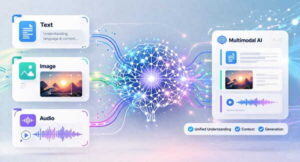
New multimodal models of conversation can process audio, visual, and text input at once to create conversation experiences with emotional engagement, contextual understanding as well as Tone Recognition.
With projects like GPT-5 and Gemini Live, we will soon see what it means to have voice and camera input as part of this next generation of chatbots!
Latency of less than 500 milliseconds, turn taking, and prosody and emotion recognition are no longer considered cutting-edge technology but are instead becoming a norm.
In order to get ready, businesses should start testing real-time voice and screen/camera interaction, specifically in key journeys such as customer onboarding or product discovery.
Those businesses using multimodal chatbots achieve great results in lead generation, onboarding, and product discovery.
This could be proven by metrics such as CSAT, AHT, and containment rate.
Trend 2 – Voice AI Beats Text
The reason why it’s important: For emergencies and cases where the customer’s intent is high, voice AI assistants will be more empathic, faster and more inclusive than text-based AI bots in 2026.
According to research conducted by Zendesk and McKinsey, the number of calls is expected to grow by around 20%, due to shrinking budgets on staffing.
Voice AI becomes a means to cope with rising demands on quality calls.
Contrary to text-based AI bots, voice-based assistants help to remove friction and make customers feel “being heard.”
Customers have a high level of satisfaction from calls made with the involvement of AI and voice assistants that take care of routine questions and route the complicated ones to human agents at the right moment.
What to do: Leaders of customer experience should implement AI voice assistants for CX in support and sales departments.
Crucially, in case of low sentiment, voice AI bots should escalate the calls to human agents.
Trend 3 – Hyper-personalization through First Party Data and RAG
Importance: Personalized journey for customers, not any generic one.
With third-party cookies being dead, personalization will depend on first party data in 2026.
When paired with Retrieval Augmented Generation, chatbots can remember contexts, predict requirements, and respond dynamically.
Examples
- Bots that prompt patients regarding their prescriptions in healthcare.
- Bots that provide personalized financial investments in finance.
- Bots that recommend products after browsing in retail.
- Result? Improved First Contact Resolution (FCR) and Net Promoter Scores (NPS).
Trend 4 – Self-Sufficient AI Agents Change the Workflow
Importance: Chatbots are evolving into self-sufficient AI agents that can complete full workflow (planning, decision-making and executing) work without human intervention.
Unlike scripted bots, self-sufficient agents are able to plan, think and execute multi-step processes such as handling refunds and rebookings, scheduling appointments or fixing devices.
According to analysts, agentic AI represents a revolutionary change in technology in 2026 when companies will start piloting autonomous agents and implementing them throughout 2027.
The point is obvious – instead of just answering frequently asked questions, the agents can do everything else, such as rebook flights, manage refunds, schedule appointments, keep product knowledge bases up-to-date, or troubleshoot devices.
Approvals, restrictions on tools, and auditing are necessary to avoid compliance issues while enjoying scaling capabilities.
Trend 5 – Vibe Coding Accelerates Chatbot Construction
An up close view of colored coding on a computer screen representing no-code AI development.
The no-code AI drives fast bot construction and customization at scale.
Why it matters: No need to write difficult code for bots anymore.
The current trend impacting AI chatbot trends is vibe coding or prompt-driven development.
You can create conversations with natural language that can be tested and iterated quickly by your teams.
With this method you ensure faster prototyping and time-to-market which keeps you ahead of your competitors in this volatile market.
The product manager will simply need to explain how a conversation should flow in plain English and test and iterate it without needing the engineers to take weeks doing this.
In addition, teams leverage vibe coding to build UI mocks, conversational flows, and utility micro-services.
Consequently, there is only one outcome: fast prototyping and reduced time to market.
Companies that used to spend months on developing conversational interfaces are now able to implement workable demonstrations in days.
For enterprises, it is important to leverage vibe coding as a sandbox for innovations and later governance, documentation, and testing to implement solutions into production.
Trend 6 – On-device/edge chatbots for privacy and latency.
Why it matters: Privacy and speed will be new differentiators.
Large language models hosted in the cloud offer immense potential, yet they tend to raise concerns over data leakage and latency.
This is why arguably one of the most significant transitions in recent years is from cloud-based chatbots to on-device models designed to ensure privacy and edge AI.
There are two primary factors that have led to this trend.
One of them is that the data of the users remains within their own devices, thus making the data more secure and helping to comply with GDPR and HIPAA regulations.
The second factor is that local inference ensures low latency and makes voice assistants work within milliseconds.
This is particularly useful for healthcare and fintech sectors where privacy and speed are of primary importance.
It’s all about cost optimization, improved performance, and greater customer satisfaction.
Conclusion
These are revolutionary and can get your AI chatbot ahead of the competition. However, the inevitable truth is to get the best out of these trends you will need to hire AI developers with experience and expertise who understand how vivid industries work.









Leave a Reply