

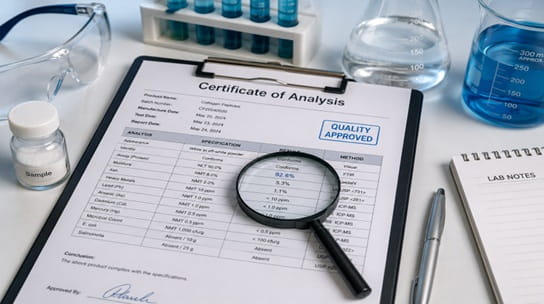
Featured Image Caption: Certificate of Analysis on Laboratory Table
Jump to read...
If you’ve ever bought a supplement, an essential oil, or even a bag of protein powder and noticed a QR code on the label pointing to a “lab report,” you’ve already brushed up against the world of Certificates of Analysis. Most people scan the code once, glance at a page full of unfamiliar abbreviations, and close the tab. At first glance, it can seem more of a document prepared for laboratory professionals than for everyday customers.
While that reaction is perfectly reasonable, it often leads consumers to ignore one of the strongest pieces of evidence for confirming what’s actually inside a product. A Certificate of Analysis, or COA, isn’t marketing material. It’s a document with a specific job: to tell you, in measurable terms, what is actually inside a product. Once you know how to read the basics, it stops looking like a wall of jargon and starts looking more like a report card.
What is a Certificate of Analysis (COA)?
A Certificate of Analysis is a formal document issued after a product, ingredient, or raw material has been tested in a laboratory. It summarizes the results of that testing in a structured format, typically listing the specific compounds tested for, the amounts detected, the methods used to detect them, and whether each result falls within an acceptable range.
Think of it as the difference between a company saying “this is pure” and a company showing the numbers that back that statement up. A COA doesn’t rely on a brand’s word. It’s generated by running a physical sample through instruments designed to measure exactly what’s present, down to fractions of a percent in many cases.
The document that comes out the other end is tied to a specific batch of product, tested on a specific date, by a specific lab, which is part of what makes it useful. It’s not a general claim about the product line. It’s a record about the exact batch that ended up in your hands, or that should have.
COAs are used far beyond supplements. They accompany raw pharmaceutical ingredients, cosmetic formulations, food additives, industrial chemicals, and agricultural products. Anywhere a buyer needs proof of what they’re purchasing before they use it, sell it, or combine it with something else, a COA tends to follow.
Why Laboratories Issue COAs
Laboratories don’t generate these reports out of goodwill. They exist because the entire supply chain, manufacturers, distributors, regulators, and eventually consumers, needs a shared, verifiable way to confirm that a product matches its description.
For manufacturers, a COA is often a legal or contractual requirement before a shipment can even be accepted. A company buying a raw ingredient in bulk isn’t going to test every batch itself; instead, it relies on the supplier’s COA as proof that what’s arriving matches the agreed specification. If that ingredient later turns out to be substandard, the COA becomes a paper trail showing where the breakdown happened.
For regulators, COAs support oversight of industries where safety margins matter, pharmaceuticals, food production, and increasingly, the supplement and cannabis industries, where testing requirements have tightened considerably in recent years. A regulatory body auditing a manufacturer will often ask to see COAs as part of confirming that quality controls are actually being followed, not just claimed.
For consumers, access to published COA provides one of the clearest ways to verify a manufacturer’s claims using actual test results rather than marketing alone.
A brand that publishes its lab reports openly, batch by batch, is signaling that it expects its products to hold up under scrutiny. A brand that refuses to share this information, or produces something vague and unverifiable, is telling you something too.
Understanding Key COA Terms Like Purity, Identity, and Batch Testing
Once you start reading an actual COA, a handful of recurring terms tend to show up. Understanding them takes most of the intimidation out of the document.
- Identity refers to confirming that the substance in the sample is actually what it’s supposed to be. This sounds obvious, but it’s a real testing category because certain plant materials, powders, and compounds can closely resemble one another. Identity testing confirms, chemically, that what’s labeled lavender oil is lavender oil, and not a cheaper oil scented to resemble it.
- Purity indicates what percentage of a sample consists of the intended substance rather than contaminants, residual materials, fillers or other unwanted products. A product listed at 99% purity means that, of everything detected in the sample, 99% of it matched the target compound. Purity numbers matter because low purity can indicate dilution, contamination, or poor manufacturing controls even if the product technically contains some of what it claims. The same critical thinking used to interpret laboratory reports can also help consumers question common health misconceptions and evaluate product claims based on evidence rather than assumptions.
- Batch testing refers to the practice of testing a specific production run; a “batch” or “lot” rather than testing a general formula once and assuming every future batch will match. Because ingredient sourcing, environmental conditions, and manufacturing variables can shift from one production run to the next, batch-specific testing is what actually tells you something about the product currently on the shelf, rather than the product as it existed whenever the original formula was validated.
You’ll also frequently see references to contaminant testing, screening for heavy metals, pesticides, microbial content, or solvent residues, and potency testing, which confirms that active ingredients are present at the concentration the label claims, neither over- nor under-dosed.
How HPLC Is Used in Laboratory Testing
The numbers on a COA don’t come from guesswork. They come from specific analytical instruments, and knowing roughly what these instruments do helps explain why a COA carries real weight.
High-Performance Liquid Chromatography, commonly abbreviated HPLC, is one of the most widely used methods for this kind of testing. In simple terms, HPLC works by dissolving a sample and pushing it through a column under pressure, where different compounds within the mixture separate from one another based on how they interact with the column material. As each compound exits the column at a different time, a detector measures it, producing a result that identifies both what’s present and in what quantity.
The reason HPLC and similar methods matter so much is precision. A trained person tasting or smelling a product can offer an opinion, but they can’t reliably tell you that a compound is present at 2.3% rather than 1.8%. Analytical instruments can. This is what allows a COA to move beyond vague reassurance and into measurable, defensible numbers.
Other common methods you may see referenced include Gas Chromatography (GC), often paired with mass spectrometry for identifying volatile compounds, and various spectroscopic techniques used for confirming molecular identity. Each method suits certain types of compounds better than others, and a thorough COA will typically note which method was used for each specific test, since the choice of method affects both accuracy and what the results can reliably claim.
Common Misconceptions People Have When Interpreting Lab Reports
A few mix-ups come up often enough that they’re worth clearing up.
- The first is assuming a COA means a government agency signed off on the product. It doesn’t. Nobody at the FDA or any equivalent body reviewed this specific document or approved what’s inside the bottle. A lab ran a sample through its instruments and wrote down what it found, that’s the whole transaction. Useful, but not the same thing as regulatory oversight, and treating it that way gives a product more credibility than the paperwork actually earns.
- Then there’s the question of who did the testing. Plenty of companies test their own products in a lab they own and issue the COA themselves. That’s not automatically a red flag, but it does mean the report isn’t independent, and independence is a big part of why COAs carry weight in the first place. Worth a quick check: is the lab named on the report connected to the seller, or separate from them?
- A clean result also doesn’t mean the product was checked for everything. Just as consumers should look beyond the front of a package when evaluating products, they should also avoid assuming a single laboratory result tells the whole story. A COA only covers what was actually on the testing panel. If pesticide screening wasn’t part of that panel, a spotless heavy-metals result tells you nothing about pesticides, the report simply never looked. It’s worth reading past the word “pass” and checking what categories were actually included.
- Age matters too. These reports are tied to a specific batch, tested on a specific date, which means a report from two years ago says almost nothing about the bottle in front of you now. Companies that take testing seriously tend to update it regularly and make it easy to match a current COA to the batch number on the product itself.
- And dense language isn’t proof of rigor. A report stuffed with technical phrasing can look impressive while quietly leaving out the numbers that matter, while a plainly written one from a solid lab can be just as thorough underneath. What actually tells you something is whether the report names the method used, the acceptable range, the result itself, and the lab behind it, not how complicated it sounds.
Reading a COA With Confidence
None of this takes a chemistry background. It just takes knowing what to look for: a named lab, ideally one with no ties to the seller; a batch number that matches what’s on your product; a clear account of what was tested and how; and results given as real numbers, not vague reassurance. The same principle applies when interpreting technical research resources, such as peptide reconstitution calculations, where transparent calculation methods help users verify dilution ratios instead of relying on manual estimates.

By John Francis
– is an independent science and health writer who covers laboratory quality standards, consumer education, and evidence-based research. His work focuses on making technical scientific topics easier to understand through practical, well-researched educational content.
Member since August, 2026
View all the articles of John Francis.












Leave a Reply