

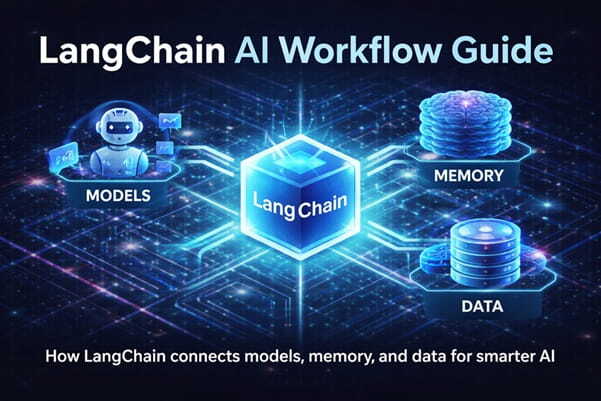
Featured Image Caption: How LangChain connects Models, Memory, and Data for Smarter AI
Jump to read...
Modern AI applications are no longer just about generating text. They are about reasoning, retrieving, remembering, and acting. This shift has led to the rapid adoption of LangChain, a framework that enables developers to build intelligent, context-aware systems powered by large language models.
This guide goes beyond surface-level explanations. It breaks down how LangChain actually works, how it fits into real-world workflows, and how you can use it to build applications that feel less like tools and more like collaborators.
What is LangChain in Practical Terms
LangChain is a development framework designed to help you connect language models with external data, logic, and workflows.
Instead of treating AI as a standalone chatbot, LangChain allows you to:
- Connect AI with databases, APIs, and documents
- Maintain memory across interactions
- Create multi-step reasoning pipelines
- Build autonomous agents that take actions
Think of it as a bridge between raw AI capabilities and real-world applications.
Why LangChain Matters Today
Traditional AI usage looks like this:
- Input a prompt
- Get a response
- End interaction
LangChain changes this pattern by introducing continuity and structure. It allows AI to:
- Remember past interactions
- Retrieve relevant knowledge dynamically
- Execute tasks step by step
- Integrate with tools like search, files, or internal systems
This makes it suitable for use cases like:
- Intelligent customer support
- Internal knowledge assistants
- Automated research tools
- Personalized learning systems
Core Components of LangChain
To truly understand LangChain, you need to see how its building blocks work together.
Models
At the core are large language models such as OpenAI GPT or other providers.
LangChain does not replace these models. It enhances how they are used.
Prompts
Prompts in LangChain are structured templates rather than plain text inputs.
They allow you to:
- Dynamically insert variables
- Standardize interactions
- Control tone and format
This leads to more predictable and consistent outputs.
Chains
A chain is a sequence of steps where the output of one step becomes the input of the next.
Example flow:
- User query
- Retrieve relevant documents
- Summarize context
- Generate final answer
This layered approach improves accuracy and relevance.
Memory
Memory enables applications to retain context across interactions.
Instead of treating each query independently, LangChain allows:
- Conversation history tracking
- Context-aware responses
- Personalized interactions
This is essential for chatbots, assistants, and long workflows.
Retrievers
Retrievers fetch relevant information from external sources.
They are often paired with vector databases to enable semantic search.
This is the foundation of Retrieval-Augmented Generation, a method that improves factual accuracy.
Agents
Agents are one of the most powerful features of LangChain.
They allow AI to:
- Decide what action to take
- Choose tools dynamically
- Execute multi-step tasks
For example, an agent can:
- Read a query
- Search a database
- Call an API
- Return a structured response
How LangChain Works in Real Applications
Let us break down a realistic use case.
Example: Internal Knowledge Assistant
A company wants an AI assistant to answer employee questions.
Without LangChain:
- The model relies only on general knowledge
- Responses may be outdated or incorrect
With LangChain:
- Documents are stored in a vector database
- A retriever fetches relevant information
- The model uses this context to answer
Result:
- Accurate
- Context-aware
- Reliable
Fan-Out Queries Explained
Fan-out queries are an advanced technique where a single user query is expanded into multiple sub-queries.
LangChain enables this by:
- Breaking complex questions into smaller parts
- Running parallel retrieval steps
- Combining results into a final answer
Example
User asks:
“Explain how AI impacts healthcare and education”
Fan-out approach:
- Query one: AI in healthcare
- Query two: AI in education
Each is processed independently, then merged.
This improves depth and clarity.
LangChain vs Traditional AI Integration
| Feature | Traditional AI | LangChain |
| Context Handling | Limited | Advanced memory support |
| Data Integration | Manual | Built-in connectors |
| Workflow Automation | Minimal | Multi-step chains |
| Flexibility | Low | Highly modular |
Key Benefits of Using LangChain
Structured Intelligence
LangChain transforms AI from reactive to structured and goal-oriented.
Improved Accuracy
By integrating external data, responses become more reliable.
Developer Flexibility
Modular design allows customization for the different use cases.
Scalability
Applications can evolve from simple chatbots to complex agents.
Challenges to Be Aware Of
Even though LangChain is powerful, thoughtful implementation is important.
- Poor prompt design can reduce effectiveness
- Memory must be managed carefully
- Retrieval quality impacts output accuracy
- Complex chains require testing and refinement
Best Practices for Using LangChain
Design Clear Prompts
Well-structured prompts improve consistency.
Use Retrieval Wisely
Only fetch relevant data to avoid noise.
Keep Chains Simple Initially
Start small and expand gradually.
Monitor Outputs
Continuously refine based on real usage.
Future of LangChain and AI Workflows
LangChain represents a shift toward composable AI systems.
We are moving from:
- Single-response models
To:
- Multi-step reasoning systems
This evolution is shaping how AI is used in:
- Enterprise automation
- Personal productivity tools
- Domain-specific assistants
The real value lies not in generating text, but in orchestrating intelligence.
Frequently Asked Questions
What is LangChain used for in simple terms?
LangChain is used to build AI applications that can think step by step, remember past interactions, and use external data sources to give better answers.
How is LangChain different from a basic chatbot?
A basic chatbot responds to a single prompt, while LangChain enables systems to handle complex workflows, retain context, and perform multiple actions before responding.
Can LangChain work without external data?
Yes, but its real strength comes from combining AI with external data sources, which improves accuracy and usefulness.
How does LangChain handle memory in conversations?
LangChain stores interaction history and uses it to generate responses that feel consistent and context-aware over time.
Is LangChain suitable for beginners?
It can be used by beginners, but understanding its components like chains and retrievers helps in building effective applications.
What is Retrieval-Augmented Generation in LangChain?
It is a method where the system retrieves relevant information first and then uses it to generate a more accurate and grounded response.
Can LangChain be used for business applications?
Yes, it is widely used for internal tools, customer support systems, and knowledge management solutions.
How do agents work in LangChain?
Agents decide what actions to take based on a query, such as calling tools or retrieving data, and then combine the results into a final response.
Does LangChain replace AI models?
No, it works alongside AI models and enhances how they are used in real applications.
What makes LangChain powerful for developers?
Its modular design allows developers to combine different components like memory, tools, and workflows into a single intelligent system.













Leave a Reply