

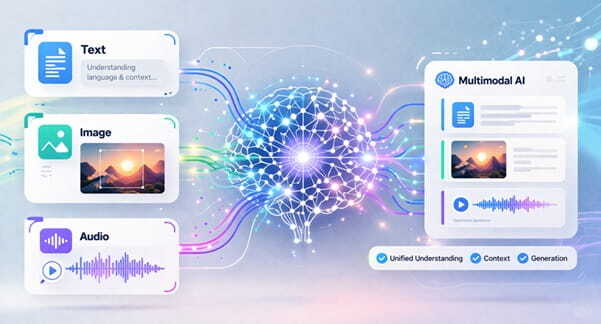
Featured Image Caption: Multimodal AI combining text, vision, and audio signals
Jump to read...
Deep learning has moved beyond single-input models into a far more capable space where systems understand multiple forms of data at once. This shift has given rise to deep learning multimodal models, a powerful approach that combines text, images, audio, and sometimes video into a unified learning framework.
These models are not just an upgrade. They fundamentally change how machines interpret the world. Instead of treating data streams separately, they connect them, much like how humans process information using sight, sound, and language together.
This article explores how multimodal models work, where they are used, and how you can build one with clarity and purpose.
What Are Multimodal Models in Deep Learning
Multimodal models are systems trained to process and relate different types of input data simultaneously. For example:
- Text paired with images
- Audio aligned with transcripts
- Video combined with contextual metadata
Traditional models focus on a single modality. A text model reads language. A vision model processes images. Multimodal systems bridge these boundaries and learn relationships across them.
Why This Matters
Real-world data is rarely isolated. Consider a simple scenario:
- A user uploads an image and asks a question about it
- A system must understand both the visual content and the text query
- This is where multimodal learning becomes essential.
Core Architecture of Multimodal Models
To understand how these models work, it helps to break them into components.
Input Encoders
Each modality has its own encoder:
- Text encoders convert words into embeddings
- Image encoders extract visual features
- Audio encoders capture frequency and tone patterns
These encoders transform raw data into numerical representations.
Fusion Layer
The fusion layer combines outputs from all encoders. There are multiple strategies:
- Early fusion merges raw inputs before processing
- Late fusion combines outputs after independent processing
- Hybrid fusion mixes both approaches
Shared Representation Space
The goal is to align different modalities into a shared space. This allows the model to understand relationships such as:
- A caption describing an image
- A sound matching a visual scene
Output Layer
The final layer generates predictions or responses based on combined understanding.
Real-World Applications
Multimodal models are already reshaping industries. Below are practical applications that go beyond theory.
Visual Question Answering
Systems analyze images and answer natural language questions. This is widely used in:
- Accessibility tools
- Customer support automation
Content Generation
Models generate images from text descriptions or vice versa. This enables:
- Creative design workflows
- Marketing content automation
Healthcare Intelligence
Combining medical images with clinical notes improves diagnostic support and decision-making.
Autonomous Systems
Self-driving systems integrate:
- Camera feeds
- Sensor data
- Map information
This combination ensures better environmental understanding.
How Multimodal Models Differ from Traditional Deep Learning
| Aspect | Traditional Models | Multimodal Models |
| Data Type | Single input | Multiple inputs |
| Learning Scope | Narrow | Context-rich |
| Complexity | Lower | Higher |
| Real-World Fit | Limited | High |
The shift is not just technical. It is conceptual. Multimodal models aim to replicate human-like understanding.
Building a Multimodal Model: A Practical Guide
Creating a multimodal system requires thoughtful design. Below is a step-by-step guide.
Step One: Define the Use Case
Start with clarity. Decide what problem you want to solve:
- Image captioning
- Speech-to-text with context
- Cross-modal search
Step Two: Prepare the Dataset
Data alignment is critical. Ensure that:
- Each modality is correctly paired
- Labels reflect real relationships
- Poor alignment leads to weak learning.
Step Three: Choose Encoders
Select appropriate architectures:
- Transformer-based models for text
- Convolutional networks for images
- Spectrogram-based models for audio
Step Four: Design Fusion Strategy
Choose how modalities interact:
- Concatenation
- Attention mechanisms
- Cross-modal transformers
Step Five: Train and Optimize
Focus on:
- Balanced learning across modalities
- Avoiding dominance of one input type
Step Six: Evaluate Carefully
Use evaluation methods that reflect real use cases, not just isolated metrics.
Challenges in Multimodal Deep Learning
Despite its potential, this approach comes with challenges.
Data Complexity
Collecting aligned multimodal data is difficult and resource-intensive.
Computational Demand
Training requires significant processing power due to multiple encoders.
Modality Imbalance
One modality may overpower others, leading to biased outputs.
Interpretability
Understanding how decisions are made becomes harder with multiple data streams.
Best Practices for Effective Implementation
To build reliable systems, consider the following:
- Normalize inputs across modalities
- Use attention-based fusion for better context alignment
- Regularly validate with real-world scenarios
- Keep models modular for easier updates
Future of Multimodal Deep Learning
The future lies in deeper integration across modalities. Systems are evolving toward:
- Unified foundation models
- Context-aware reasoning
- Real-time multimodal interaction
These advancements will shape how humans interact with machines across industries.
Frequently Asked Questions
What is a simple example of a multimodal model?
A simple example is an image captioning system where the model looks at a picture and generates a sentence describing it. It uses both visual and language understanding together.
How is multimodal learning different from transfer learning?
Transfer learning reuses knowledge from one task to another, while multimodal learning combines different types of data at the same time to improve understanding.
Can beginners build multimodal models?
Yes, beginners can start with pre-trained components and combine them using simple fusion techniques. Starting with small datasets helps in understanding the workflow clearly.
What are the key skills needed for multimodal AI?
You need a strong grasp of deep learning fundamentals, experience with handling different data types, and an understanding of model architectures like transformers.
How do you handle missing modalities during inference?
One approach is to train the model with partial inputs so it learns to adapt. Another method is to use fallback mechanisms that rely on available data.
Are multimodal models suitable for real-time systems?
They can be used in real-time systems if optimized properly. Efficient model design and hardware acceleration play an important role here.
How do attention mechanisms help in multimodal models?
Attention allows the model to focus on relevant parts of each modality, improving how different inputs are aligned and interpreted together.
What is the biggest limitation of multimodal AI today?
The biggest limitation is the difficulty in obtaining high-quality aligned datasets, which directly affects model performance and reliability.
How to start a project in multimodal deep learning?
Begin by selecting a clear use case, gather paired data, choose simple encoders, and experiment with basic fusion methods before moving to complex architectures.








Leave a Reply