

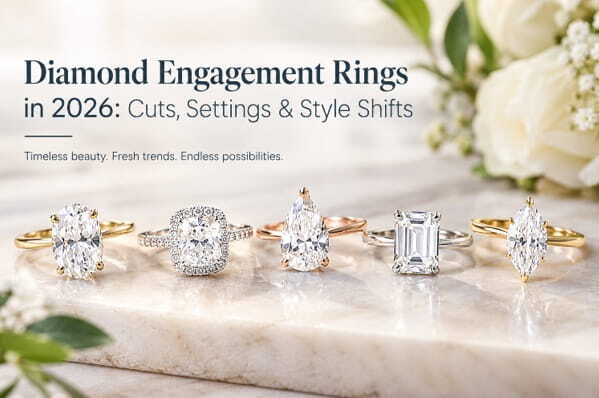
Featured Image Caption: Five Different Diamond Engagement Rings Lined up on a Marble Surface
Jump to read...
Diamond engagement rings are taking a more personal direction in 2026. While timeless designs remain popular, couples are increasingly exploring unusual diamond shapes, distinctive settings, mixed metals, and details that make a ring feel individual. The focus is shifting away from choosing a design simply because it is traditional or widely seen and toward finding a ring that reflects personal taste.
This year’s styles offer plenty of room for both classic and contemporary preferences. A traditional round diamond can still create an elegant engagement ring, while an oval, marquise, emerald, or pear-shaped stone can provide a more distinctive appearance. Settings are changing too, with bezel, east-west, three-stone, and sculptural designs’ giving familiar diamond shapes a fresh look.
Diamond Cuts Defining Engagement Ring Style in 2026
The round brilliant cut continues to have a strong place in engagement-ring design. Its symmetrical shape and classic appearance make it easy to pair with almost any setting or wedding band. For couples who want something timeless, a round diamond remains a straightforward choice that can work across different styles.
At the same time, elongated diamond shapes are attracting plenty of attention. Oval diamonds offer a graceful silhouette and can create the appearance of a larger stone because of their elongated outline. They work particularly well in solitaire settings, where the centre diamond remains the main feature.
Pear-shaped diamonds bring another type of character. Their combination of a rounded end and pointed tip creates a distinctive shape that can look elegant without feeling overly traditional. The direction of the stone can also change the overall appearance of the ring.
The marquise cut is another shape receiving renewed interest. Its long, pointed design has a vintage connection but can look surprisingly modern when paired with a simple band or contemporary setting. An east-west arrangement can make the shape even more distinctive.
For those who prefer clean lines, emerald-cut diamonds offer a sophisticated alternative. Their step-cut facets produce broad flashes of the light rather than the intense sparkle associated with brilliant cuts. This gives the stone a sleek and architectural appearance.
Elongated cushion cuts are also appealing to couples who want softer edges with a longer profile. They combine the romantic appearance of a cushion shape with proportions that feel contemporary.
Engagement Ring Settings Taking a New Direction
The setting has a major influence on how a diamond looks, and 2026 designs are giving this part of the ring more attention. The classic solitaire remains popular, but it is being interpreted through different band shapes, metal choices, and mounting styles.
Bezel settings are particularly interesting for modern engagement rings. Instead of holding the diamond with visible prongs, metal surrounds the outer edge of the stone. This creates a smooth, clean appearance while offering protection around the diamond. A bezel setting can give an oval, emerald, or other elongated shape an especially contemporary look.
Another design gaining attention is the east-west setting. Rather than positioning an elongated diamond vertically along the finger, the stone is placed horizontally. An oval, marquise, emerald, or similar shape can look completely different when turned sideways. This small change can make a traditional diamond feel much more individual.
Three-stone engagement rings are also an appealing option for couples who want more detail than a solitaire provides. A larger centre diamond can be accompanied by two smaller stones, creating a balanced design with additional sparkle. Different diamond shapes can also be combined for a less predictable appearance.
The band itself is becoming more important as well. Instead of extremely delicate bands being the only fashionable choice, wider bands and sculptural designs are appearing alongside classic profiles. Curved edges, textured metal, unusual proportions, and subtle detailing can turn the band into a major part of the ring’s design.
Vintage Influence Meets Modern Design
Vintage-inspired engagement rings continue to influence 2026 styles, but they do not necessarily have to look old-fashioned. Antique-inspired diamond shapes, detailed metalwork, milgrain accents, and traditional settings can be combined with cleaner modern elements.
Older diamond cuts can be particularly attractive to couples looking for something different from the standard brilliant-cut appearance. Their distinctive faceting and softer shapes can give a ring more visual character.
One approach is to combine a vintage-inspired centre stone with a simple contemporary band. Another is to use traditional detailing around an otherwise modern setting. These combinations allow couples to borrow elements from different periods without creating a ring that feels tied to one particular era.
Yellow gold also works naturally with vintage-inspired designs. Its warmer appearance can create a softer overall effect, while white gold and platinum provide a brighter, more contemporary finish. Rose gold remains another option for those who want a warmer and more distinctive metal tone.
Mixed-metal designs can take this idea even further. Combining two metal colours can add contrast without requiring additional gemstones or elaborate decoration.
Personal Style Matters More Than Following Trends
One of the biggest changes in engagement-ring design is the growing emphasis on individuality. Couples have access to a much wider range of combinations than the traditional diamond-and-band formula.
A person might choose an oval diamond but place it in a bezel setting. Someone else might prefer an emerald-cut stone in an east-west orientation. A marquise diamond can be paired with a simple gold band, while a round brilliant can be given a distinctive appearance through an unusual setting.
Toi et moi rings, which feature two prominent stones instead of one central diamond, are another way to create a more personal design. The two stones can be similar or intentionally different, allowing couples to experiment with shape, colour, and proportion.
Coloured gemstones can also bring personality to an engagement ring. They may be used as side stones, accent details, or centre stones for couples who want an alternative to an entirely white-diamond design.
This focus on personalisation does not mean classic rings are disappearing. In fact, traditional designs remain appealing because they can be worn comfortably across changing fashion cycles. The difference is that couples now have more freedom to modify classic designs rather than choosing them exactly as they have always appeared.
Natural and Lab-Grown Diamonds in 2026
The choice between natural and lab-grown diamonds is another consideration for today’s engagement-ring shoppers. Both options have become part of the modern diamond market, giving buyers different ways to approach their purchase.
Natural diamonds are formed through geological processes over extremely long periods and remain closely associated with the traditional engagement-ring market. Lab-grown diamonds are created using controlled technological processes and have the same basic chemical composition as natural diamonds.
For many buyers, the decision comes down to personal priorities, budget, and preferences regarding diamond origin. Regardless of which option is selected, the quality of the individual stone remains important.
The 4Cs -cut, colour, clarity, and carat weight– continue to provide a useful framework when comparing diamonds. Cut affects how effectively the stone interacts with light, while colour and clarity influence its appearance. Carat refers to weight rather than directly determining how large a diamond looks.
The proportions of a diamond can also have a significant visual impact. Two diamonds with the same carat weight may appear quite different depending on their shape and dimensions.
What Will Define Engagement Rings in 2026?
There is no single engagement-ring style that represents 2026. Instead, the year is characterized by greater variety and more freedom to combine different design elements.
Classic round diamonds continue to offer a timeless option, while elongated cuts provide a more contemporary silhouette. Bezel and east-west settings can transform familiar shapes, and vintage-inspired details add character without requiring an entirely traditional design.
The most noticeable shift is toward rings that feel chosen rather than simply selected from a standard formula. Couples are mixing metals, experimenting with proportions, considering unusual diamond orientations, and incorporating details that have personal meaning.
For some, that may mean a simple solitaire with a wider gold band. For others, it could be a vintage-inspired marquise, an east-west emerald cut, a two-stone design, or a sculptural custom setting.
Ultimately, the appeal of 2026 engagement-ring trends lies in the freedom they provide. Rather than following one defined look, couples can take inspiration from current styles and create a combination that feels right for them. The result is an engagement ring that can reflect contemporary design while still carrying the timeless meaning associated with the piece.

By Diana Patterson
who is a jewellery blogger based in London, UK. She is passionate about antique and vintage jewellery and loves to blog about ways to style these rare jewels. She also covers the contemporary jewellery designs while collaborating with industry insiders and designers like Hancockslondon to get insight on the latest trends.
Member since October, 2026
View all the articles of Diana Patterson.






Leave a Reply