

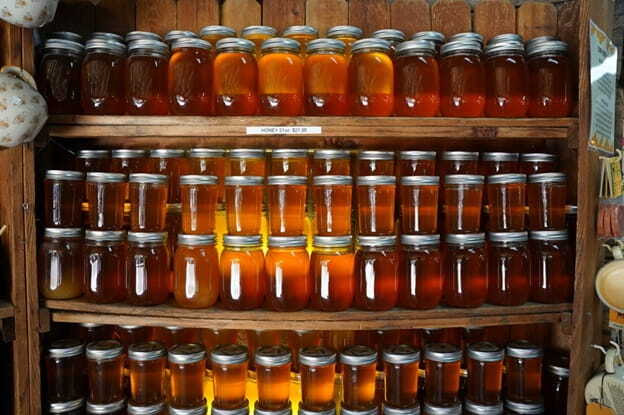
Featured Image Caption: Rows of jars of honey sit on a shelf.
Jump to read...
Honey – the most versatile superfood out there – ranks up there in a category all of its own. A staple of ancient Ayurveda and an established commodity within kitchens and cabinets worldwide, honey has been undergoing a significant business resurgence in India. The India Honey Market no longer solely represents a meek product in a grocery aisle but has morphed into a growing, multi-crore sector that is driven by discerning health conscious shoppers, encouraging government initiatives, aspirations for a stronger export market, and an explosion of all-natural, wholesome products. With India being one of the largest honey producing and exporting countries globally, understanding the current dynamics of this sector can provide immense business intelligence.
Overview of the India Honey Market
India Honey Market Size: India honey market size reached Rs 25.31 billion in 2025 and is expected to reach Rs 65.65 billion by 2035, growing at a CAGR of 10.00%. The robust growth rate is attributed to major structural transformation including increased demand for natural sweetener due to rising consumer concerns about health in urban areas as well as increasing use of honey in pharmaceuticals and nutraceuticals products. India became the 2nd largest honey exporting country in the world in 2024.
India boasts a long history of beekeeping, with a broad range of natural floral diversity available from the Himalayas to the coasts of Kerala and the desert landscape of Rajasthan, all of which can serve as valuable sources for the production of honey and other hive products. Supported by growing investments in infrastructure development, the India Honey Market has established itself as an important source of food security as well as exports.
Key Market Statistics at a Glance
- Market Value in 2025: INR 25.31 Billion
- Projected Market Value by 2035: INR 65.65 Billion
- CAGR (2026–2035): 10.00%
- India’s global export rank: Second-largest honey exporter (as of 2024)
- Dominant honey flavour: Multiflora honey with a 34% market share
- Leading state by market share: Rajasthan (24%), owing to favourable agro-climatic conditions
- Top export destination: The United States holds the commanding share of Indian honey exports
- National Beekeeping and Honey Mission: 6 world-class and 47 mini testing labs established by March 2025
Popular Honey Varieties Driving the India Honey Market
India has an outstanding diversity to offer such that many types of honey are produced which offer variety in flavors as well as in nutrients that the consumers demand. Given flavors which are in much demand for in India Honey Market:
Multiflora Honey
The clear market winner is Multiflora Honey at a 34% market share – harvested from bees who fly between a range of different floral species. The balanced sweetness of its flavour profiles ensures that it is the predominant choice in the home, workplace and as a general food and beverage ingredient.
Eucalyptus Honey
The eucalyptus honey mainly manufactured in the southern India has a slightly medicine-like flavor which is well-known for its remarkable effect on respiratory wellness. Therefore, it is widely used by brands of nutraceuticals and health & wellness consumers.
Ajwain Honey
Ayur Honey: These honeys are derived from carom flower crops that are abundant throughout North India. They contain many essential minerals, which give honey special medicinal benefits. Carom honey is widely accepted as beneficial to digest & having anti-microbial properties. These are increasingly valued in Ayurvedic remedy & amongst health conscious & health food manufacturers that look to capitalize on the growing trend for ‘functional food’.
Sidr Honey
Sidr The most luxurious in the Indian money Market is honey extracted from Sidr or Jujube trees and mainly collected from Rajasthan and Uttar Pradesh. Its price is extremely expensive, and it is a hot sell in the Middle East and overseas specialty stores.
Multi-flora Himalayan and Exotic Varieties
Rare and exotic varieties of honey like Multi-flora Himalayan honey, lychee honey, wild forest honey produced in India’s Northeastern States and Maharashtra, fetch high value in the domestic specialty retail market as well as international export markets.
Key Growth Drivers of the India Honey Market
Rising Health Consciousness
Indians are increasingly challenged by lifestyle diseases. Around 77 million Indian adults suffer from Type 2 diabetes while 25 million have prediabetes; thus, a consumer trend towards alternatives for refined sugar is emerging. Honey can be the best substitute, considering its taste, antibacterial, anti-inflammatory and antioxidants properties are the driving forces for the India Honey Market.
Government Support Through the National Beekeeping and Honey Mission
India’s government has enthusiastically poured money into beekeeping through the NBHM initiative. 6 world class testing and 47 mini testing laboratories were set up nationwide by March 2025, increasing quality control and the reliability of the honey supply chain. Government support towards research, market development and export promotion is helping speed the formalization of the sector
E-Commerce and Modern Retail Expansion
The Indian e-commerce market is set to account for 270 million online shoppers in 2024, making it a gamechanger for many honey brands in India. With this rapid growth, honey players have gained the flexibility to access a pan-Indian consumer base without investing in physical store operations. In fact, the India Honey Market is now heavily dominated by B2C channels, contributing for 57% share that includes the online marketplace and modern formats.
Export Growth and Global Demand
There have been strong growth rates of India’s exports, and it stands second largest honey exporting nation in the world. In terms of destinations the United States dominates our honey exports, followed by Europe, Middle East and Southeast Asia. Indians are targeting the niche high-value markets, primarily through investments in traceability, quality certification and premium packaging.
Emerging Trends Reshaping the India Honey Market
- Natural and Raw Honey Demand on Rise Demand for natural and raw honey products with chemicals is catching on consumers’ pace faster than the traditional honey. As manufacturers start adopting various organic certificates and advertising higher value of nutrient content of the honey, it’s attracting more well-heeled customers in the metro cities.
- Functional and nutraceutical use: The uses for honey continue to expand beyond consumption and is now being integrated into products for the pharma sector, beauty (skincare products like face masks), nutraceutical products (immunity boosters and such) such as immunity supplements and even cough medicines and in dressing wounds.
- D2C Brands: Fresh blood of honey-focused brands, is getting pumped into this industry, using all social platforms, influencer Marketing, and storytelling of brand promise like origin, purity is turning loyal customers base particular young ones millennials and Gen Z to be brand ambassadors for this niche products.
- Premiumisation and Specialty Honey: Consumers tend to be willing to pay higher prices in particular for specialty honey, for instance raw honey, single origin honey and organic honey and natural raw honey, particularly from wild harvested natural combs. The “specialty honey” form such as the raw honeycomb, wild honeycomb infused honeys, packs etc, and gift sets are contributing to the premium portion of the Indian honey market.
- Industry Collaboration: Four hundred beekeepers attended IHA’s 4th Annual General Meeting in New Delhi in September 2025, an event involving the whole honey value chain. Collaboration was a common theme around beekeeper safety, educating consumers on pure honey and industry-wide honey standards.
Challenges Facing the India Honey Market
While the growth of the India Honey Market is indeed remarkable, there are a number of critical issues that the market participants need to pay heed to:
- Adulteration Issues: Honey has had the longest and biggest problem with consumer confidence on several levels from whether it contains traces of the herbicide glyphosate, to if the product has actually had sugar added to it! Companies and governments need to invest further in testing infrastructure, coupled with transparent labelling to ensure a more trusting market.
- Price Fluctuation: Honey prices vary due to season, and climate changing bees in colony to become unstable. The unpredictable factor causes producers and exporters have to put pressure on them, especially smaller businesses.
- Quality and export standards: The strict regulations of quality and residues that the EU, USA and other target export countries require are met by the continuous investment to tester capacity, trace supply chain.
- Modernising the Supply Chain: Most honey production is still handled by loosely organized supply chains. Connecting smallholder beekeepers to organized markets is a major infrastructure deficit.
- India’s Honey: Currently India is exporting honey at considerably low per unit values, whereas honey import value for high end honey is much higher, suggesting a quality differential within domestic Honey that does not permit extraction of maximum potential.
Key Players in the India Honey Market
FMCG majors, the Ayurveda-focused companies, organic businesses and even agri-cooperatives represent a few among others in this sector. Some of the companies engaged in India Honey Market are:
- Dabur India Limited – This brand leads with solid equity of Dabur honey, coupled with their strong pan-India distribution network. Patanjali Ayurved Limited, Known for their Ayurvedic brand position, which plays key role in promoting consumption of natural honey by masses. This brand has gained stronghold on reach to rural markets.
- Apis India Ltd – Holding a key position amongst largest honey processors of India, with high capability in exports and a wider product offering.
- Organic India Pvt. Ltd. – An organic and Ayurvedic brand focusing on certified organic honey, with product range designed for health focused urban Indian customer base. Saffola (Marico), Wellness brand which is now into premium honey for people that focus on health and fitness. Baidyanath and Zandu Care, Two oldest Ayurvedic brands that now feature pure honey in their product lines.
- Nature’s Nectar (Kejriwal Bee Care India Pvt Ltd) – One of largest brand dealing into pure and raw honey and with high authenticity on quality certifications.
Conclusion
The Indian honey market stands at a pivotal juncture, transitioning from an agrarian tradition to a surging consumer market spanning health, wellness, food science and global commerce. At 10.00% CAGR thru 2035, the sector is outpacing other food and beverage sub sectors, for sound reasons. Combined pressures of health awareness, growing e-commerce capabilities, support from state policy, exports, and an innovative cadre of quality-aware manufacturers, the Indian honey market provides one of the best investments opportunities in the country’s agro-food domain.
Still, there are inherent issues like adulteration, supply chain divisiveness and export quality which need careful addressing.
Business with expertise in tracing, certification and public education will prosper in this valuable space. Whether your focus is on business, investment or policymaking, for your needs for deep and data driven details of the Indian honey market such as flavouring, circulation, utilization and regions, turn to expert Market Research for insights. Having a lot of experience working in India’s agricultural and food arena, Expert Market Research helps guide you.
Frequently Asked Questions (FAQs)
Q1. What is the size of the India Honey Market currently?
India Honey Market size was approximated to be INR 25.31 Billion in 2025 and is anticipated to expand at a CAGR of 10.00% to reach INR 65.65 Billion by 2035. The growing health consciousness and rising consumer demand for natural and healthy foods is fuelling up the growth of this market. Moreover, support from government such as National Beekeeping and Honey Mission is another prominent factor.
Q2. What type of honey is best in India?
Market Leader by Value In India India’s most consumed variety of honey is the Multiflora honey. This type commands a 34% market share in 2025. Factors such as easy availability, versatility of use, and favourable price have contributed to making multiflora a household name and a first choice for F&B manufacturers and regular traders.
Q3. Which country is the largest exporter of honey?
The Indian honey market has seen significant growth, and in 2024, India is the second-largest honey-producing and exporting country in the world. The large biological diversity of the country-from the Himalayas in the north to the states in the south-enables us to produce many varieties of flower honey. Government involvement, via the National Beekeeping and Honey Mission, was essential for building the quality infrastructure necessary for the product to compete in markets that are major importers of honey, such as the US, Europe, and the Middle East.
Q4. What about the Role of the Indian Honey Market within the domain of E-commerce?
The e-commerce channel stands as an important growth engine for the Indian Honey Market. Being the country with 270 million internet buyers of consumer products in 2024, India’s e-commerce platforms serve as an effective and wide distribution network, available to be leveraged by old time national honey brands as well as niche organic honey suppliers, to reach out to consumers across the entire country. Business-to-Consumer, representing a share of 57% of the market distribution, consists of E-commerce channel as one among the rapidly emerging distribution channels.
Q5. What are the major obstacles for India Honey market?
Among the main hurdles to the India Honey market, the quality of honey is contaminated due to an unfair trade practice, loss of confidence among customers due to lack of purity, variation in prices owing to climatic and seasonal events, requirements of meeting the international standard for export quality, and scattered supply chains restricting the share of small beekeepers. Efforts to tackle the problems needs collective efforts of stake holders, organizations.








Leave a Reply