

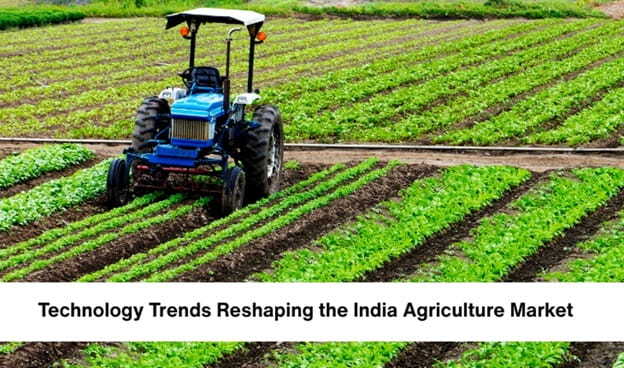
Featured Image Caption: Blue Tractor in Green Field
Jump to read...
India’s agriculture is entering a new era of innovation, digitization and sustainability. Farming has always been based on experience and seasonal patterns, but new technologies are changing how crops are grown, cared for and delivered. With the increasing population and urbanization, the demand for food is also increasing and the advances in technology are playing a vital role in improving productivity and strengthening the Indian Agriculture Market. Farmers, agribusinesses and policymakers are adopting smart solutions more and more to increase efficiency, use natural resources more efficiently and increase resilience to climate-related challenges.
Digital Farming Creating Smarter Agricultural Operations
In India, modern technologies have become a necessary and great helping hand to farmers since they help them in their decision-making concerning the farming process. Farmers have the possibility to use such digital tools as applications for smartphones, various websites where they can receive advice online, and programs for farm management. Now, it’s not only important to apply traditional knowledge but also to use advanced technologies.
Digital marketplaces become popular and provide farmers with new access to markets by allowing them to communicate directly with buyers. These platforms establish transparent pricing and free farmers from the necessity of using middlemen. As more people get access to the Internet in rural areas, digital agriculture is going to become more popular.
Precision Agriculture Improving Resource Efficiency
Efficient resource management is the primary concern of the India Agriculture Market due to the scarcity of resources like water and the rising cost of agriculture resources. Precision in agricultural practices involves the use of GPS technology, satellite imagery, sensors in the soil, and Geographic Information Systems (GIS) to monitor the conditions of the fields. These technologies allow farmers to gain precise insights into the crops in their fields.
Instead of applying fertilizers, pesticides, and water uniformly across their fields, farmers can utilize precision agriculture to only treat the areas within their fields that require treatment. This method conserves resources like fertilizers and water for the fields that need them the most, minimizing the cost of farming for the farmers and improving the crop performance. Additionally, precision agriculture benefits the environment by conserving resources and reducing the environmental damage caused by the overuse of fertilizers and water.
Artificial Intelligence Strengthening Farm Decisions
Artificial Intelligence (AI) is emerging as one of the most transformational technologies for the India Agriculture Market. AI systems mine huge amounts of agricultural data to detect disease outbreaks, predict pest infestations, estimate crop yield, and assess weather-related risks. This means that farmers can react quickly and cut potential losses.
The more data machine learning models have, the better they become, so recommendations improve over time. AI is also helping agribusinesses with demand forecasting, inventory planning and supply chain optimization. As cheap digital tools become more widely available, the use of AI in farms of all sizes will likely grow.
Drone Technology Expanding Modern Farming Practices
Drone applications are gaining momentum in the India Agriculture Market. Using advanced cameras and imaging sensors, these devices can identify the health of the crops and provide farmers with valuable information about crop diseases or nutrient deficiencies in a short period.
Additionally, drones can spray fertilizers or pesticides directly onto the crops with precision. Spraying with drones significantly improves the efficiency of handling large agricultural fields.
Smart Irrigation Supporting Sustainable Agriculture
Water conservation remains one of the biggest priorities in Indian agriculture. Smart irrigation systems are helping the India Agriculture Market address this challenge by delivering water based on actual crop requirements rather than fixed schedules. Soil moisture sensors, automated irrigation controllers, and Internet of Things (IoT) devices continuously monitor field conditions and regulate water usage accordingly.
These intelligent irrigation solutions reduce water wastage, lower energy consumption, and improve crop productivity. They are particularly valuable in regions experiencing irregular rainfall and declining groundwater levels. Sustainable irrigation practices not only improve farm profitability but also contribute to long-term environmental conservation.
Agritech Startups Accelerating Innovation
The country has seen a significant increase in the number of agritech startups working on new and imaginative products and services along the agricultural value chain. All kinds of companies have popped up in India from digital marketplaces and fintech solutions to farm mechanization and precision farming establishments.
Furthermore, many of these startups are working to connect farmers with things such as credit, agricultural insurance, quality seeds, agricultural equipment rental, or consulting based on accurate data. Many other companies are engaged in improving the effectiveness of the supply chain by minimizing post-harvest losses and connecting farmers with processors, retailers, and exporters.
Mechanization Increasing Agricultural Productivity
Farm mechanization is changing the India Agriculture Market by decreasing reliance on labor and improving operation efficiency. Modern tractors, harvesters, seed drills & automated planting equipment enables farmers to carry out agricultural activities faster and more accurately than traditional methods.
Mechanization is now within reach of small and medium-sized farmers thanks to the increasing availability of machinery through rental platforms and cooperative service models. Efficiency gains help farmers grow and harvest crops on time, leading to more output and cheaper production costs.
Sustainability Becoming a Long-Term Growth Driver
Sustainability in the agriculture sector is of increasing importance to environmental concerns. Farmers are turning to various climate-smart farming techniques that will allow their farms to remain productive in the long term.
The use of technology in the agriculture sector allows for increased sustainability in farming practices. As the governments and private organizations around the world place an increased focus on environmentally-friendly farming practices, sustainability will be a key feature of the India Agriculture Market.
Conclusion
Technology is redefining every stage of agricultural production, from field preparation and crop monitoring to harvesting and market access. Digital farming platforms, artificial intelligence, drone technology, precision agriculture, smart irrigation, mechanization, and agritech innovation are collectively strengthening the Indian Agriculture Market by improving efficiency, productivity, and sustainability. As technology adoption continues to expand and supportive government initiatives encourage modernization, India’s agricultural sector is well positioned for long-term growth. Businesses, investors, and industry stakeholders that monitor these technological trends will be better equipped to capitalize on the emerging opportunities within the rapidly evolving India Agriculture Market.

By Steven Taylor
who is a market research analyst and professional business content writer with a strong interest in sustainability, emerging industry trends, and global market developments. He specializes in creating well-researched, insightful articles that explore evolving consumer behavior, technological advancements, and business strategies across diverse industries. His work focuses on delivering practical, data-driven perspectives that help readers stay informed about market innovations and long-term industry growth.
Member since July, 2026
View all the articles of Steven Taylor.












Leave a Reply