

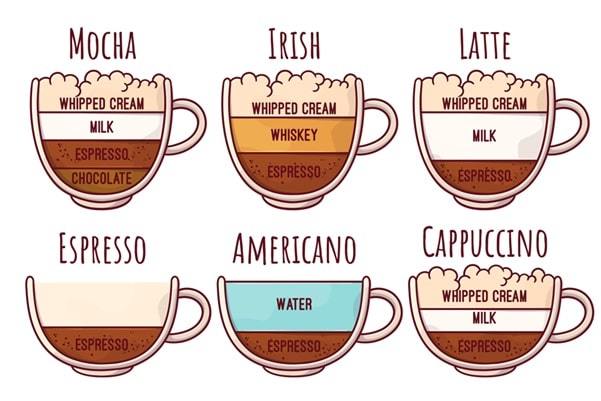
Featured Image Caption: Hand Drawn Collection of Coffee Types
Jump to read...
A Definitive Deep Dive Into the World’s Favorite Daily Ritual
Coffee is one of those rare global unifiers, a beverage woven so tightly into the fabric of human civilization that it has become ritual, identity, fuel, culture, and, occasionally, controversy. Whether you sip it, gulp it, worship it, or can’t stand the taste of it but still love the smell when someone else brews it, coffee is the world’s social heartbeat. More than 2.25 billion cups are consumed each day, which means right now, at this very moment, millions of people across continents are raising steaming mugs in silent communion.
But behind this familiar beverage lies a wild, surprising, and occasionally unbelievable history. Coffee has shaped economies, spurred revolutions, been outlawed (multiple times), funded an Olympic voyage, ignited fears of moral decay, and inspired a marketplace where beans born from animal digestion can cost more than many people’s monthly rent.
So settle in with your favorite cup whatever it is, however you take it and let’s dive into a world of stories, science, and delightful weirdness. Here are the most compelling, eye-opening, and wonderfully eccentric fun coffee facts to get your curiosity brewing.
How Coffee Sent the Brazilian Olympic Team Across the World
The year was 1932. The Olympics were being hosted in Los Angeles, but Brazil, in the throes of economic difficulty, couldn’t afford to send its athletes across the Atlantic. Instead of forfeiting the world stage, the nation turned to its most dependable economic ally: coffee.
Brazil loaded a ship with coffee beans and sent its athletes on an improbable transoceanic voyage. As the ship traveled, the crew and athletes sold coffee port by port, raising enough money along the route to reach California.
Imagine training for the Olympics, then suddenly becoming a floating coffee merchant just to get there. If there were ever a tale that perfectly captured the intersection of determination and caffeine, this is it.
Coffee May One Day Power Your Car
Science has always flirted with turning the ordinary into the extraordinary, and coffee grounds those humble leftovers from our morning routine are one of the latest targets of innovation.
Researchers around the world have discovered that used coffee grounds contain oils that can be converted into biodiesel. The idea is more than a lab experiment; many engineers see promise in using this waste product as a viable alternative fuel.
Picture it: topping off your car’s tank with a blend derived from yesterday’s espresso. The future may smell like French roast.
Finland Drinks More Coffee Than Any Country on Earth
If you thought the Italians were the champions of coffee culture, or that Americans with their venti cold brews were the greatest caffeine consumers, prepare to adjust your worldview.
Finland, a nation with zero domestic coffee production, holds the global title for the highest per-capita coffee consumption. The typical Finn drinks four cups per day, a serious commitment to the bean.
In a country known for long winters, near-mythic sauna culture, and a national temperament leaning toward introspection, coffee functions almost as social glue. It’s not just a beverage; it’s a daily rhythm, a warmth, a gathering point in homes and workplaces alike.
Coffee Has Been Banned – Repeatedly – Throughout History
Coffee’s global popularity wasn’t inevitable. In fact, multiple governments across centuries have tried (and failed spectacularly) to outlaw it.
The 18th-century crackdown
By the 1700s, coffeehouses across Europe had become hotbeds of political debate, satire, and intellectual ferment. Governments saw these spaces as suspicious places where citizens gathered to think, challenge, question, and discuss.
Sweden went so far as to ban not only coffee but also accessories: cups, glasses, saucers, and anything coffee-related. Imagine police raiding your home over a porcelain mug.
The 17th-century Ottoman ban
During the Ottoman Empire, coffee was believed by some rulers to possess hallucinogenic or narcotic effects. One sultan, convinced it was dangerous, made drinking coffee in public a capital offense.
Coffee drinkers, of course, didn’t stop. They never do.
The World’s Most Expensive Coffee Comes From Animal Feces
It sounds like a culinary dare gone wrong, but Kopi Luwak, one of the priciest coffees in the world is made from beans that have passed through the digestive system of the Asian palm civet.
These animals eat ripe coffee cherries but cannot digest the beans, which emerge. intact. Farmers collect the droppings, extract the beans, wash them thoroughly (thankfully), then process and roast them. The result? A smooth, low-acid coffee with a flavor profile many swear by.
But Kopi Luwak is also controversial due to animal welfare issues so while it’s a fascinating fact, it’s also a reminder of the strange lengths humans go to for novelty and flavor.
Coffee Drinkers Tend to Live Longer
Here’s a fact that delights millions: several large studies including research highlighted by Harvard Health Publishing have found that people who drink three to four cups of coffee a day tend to live longer than non-coffee drinkers. The benefits include a lower risk of:
- cardiovascular disease
- type 2 diabetes
- parkinson’s disease
While coffee isn’t a magical elixir of immortality, it is rich in antioxidants and bioactive compounds that help protect cells from stress and inflammation.
Your morning cup isn’t just a ritual. It’s a (delicious) act of self-care.
Coffee Can Boost Your Metabolism – And Your Workout
Caffeine is a natural stimulant that increases metabolic rate, improves alertness, and enhances physical performance. Fitness trainers often recommend drinking coffee before exercise to maximize fat burning and endurance.
It’s also why the gym crowd’s water bottles often contain suspiciously dark liquids.
Germany Banned Coffee Pods in Government Buildings
Coffee pods, those convenient, single-serve capsules used in machines like Nespresso, aren’t universally loved. In Germany, government buildings banned them in 2016 due to environmental concerns, noting that they produce large amounts of unnecessary aluminum-based waste.
It’s a rare case where bureaucracy acted faster than a caffeine molecule can hit your bloodstream.
The CIA Headquarters Has Its Own Starbucks – With Special Rules
In Langley, Virginia, deep within the CIA’s main complex, sits a Starbucks unlike any other. Agents call it the “Stealthy Starbucks,” though nothing about the place is ordinary.
The staff undergoes extensive background checks, cannot leave their station without an escort, and don’t call out customers’ names. Not because it’s awkward but because shouting “double espresso for Agent Smith!” is probably a national security issue.
Coffee May Reduce the Risk of Suicide
A striking statistic: consuming two to four cups of coffee a day has been associated with a 50% lower risk of suicide. Researchers theorize that caffeine enhances the production of neurotransmitters like dopamine and serotonin, improving mood and emotional resilience.
It’s one of the most profound reminders that coffee is more than a pick-me-up. For some, it’s a psychological stabilizer.
Instant Coffee Is Older Than You Think
Instant coffee might feel like a modern convenience, but its origins go back almost 250 years. It was first introduced in England in 1771. Production didn’t scale until 1910, when the United States patented and mass-produced the first commercial instant coffee.
Today it’s a global staple especially in regions where convenience and portability outweigh the romance of brewing.
Your Body Clears Caffeine in About 10 Hours
The pharmacology of coffee is surprisingly elegant. Here’s the timeline:
- 30–60 minutes: caffeine’s effects peak
- 5 hours: about half the caffeine you consumed is eliminated
- 10 hours: most or all of it is gone
Of course, genetics and sensitivity vary, which explains why some people can drink espresso at midnight and sleep like a baby while others feel jittery after half a cup at noon.
The Truth About the Arabic Word “Qahwah”
Many casual articles claim that the word qahwah originally referred to a type of wine. This is incorrect.
Qahwah has always meant coffee in Arabic, referring specifically to the drink made from roasted beans. It was never used as a name for wine in the historical or linguistic record of Arabic-speaking cultures.
What did happen is that European languages adapted the word phonetically:
- qahwah → kahveh (Turkish)
- kahveh → koffie (Dutch)
- koffie → coffee (English)
It’s a linguistic relay race, but the meaning has always been tied to the beverage we know today.
Before Coffee, Americans Drank Beer for Breakfast
In Colonial America, clean water wasn’t always guaranteed, so people including children often drank cider or weak beer with their morning meals.
Coffee didn’t become ubiquitous in the U.S. until the late 18th and early 19th centuries, thanks in part to trade expansion and, ironically, a rebellion against British tea taxes. The Boston Tea Party wasn’t just a political statement; it nudged America toward a new preferred beverage.
The First Coffee Wasn’t Brewed – It Was Chewed
Historically, coffee wasn’t always a drink. Many African tribes consumed coffee by mixing ground coffee cherries with animal fat and molding them into edible energy balls. These early snacks were portable and potent, the prehistoric equivalent of caffeinated protein bars.
It wasn’t until later that people began soaking and brewing the beans.
Coffee Consumption May Reduce Prostate Cancer Risk
Some studies suggest that men who drink six or more cups of coffee daily may reduce their risk of developing prostate cancer by up to 20%. While the research isn’t definitive, the correlation is strong enough to intrigue medical scientists.
Six cups a day is not for the faint of heart or faint of stomach but the finding is fascinating nonetheless.
The 17th-Century Women Who Declared Coffee Was Turning Men Into “Useless Corpses”
In 1674, an anonymous group of disgruntled English women published The Women’s Petition Against Coffee. The document accused coffee of rendering men impotent, listless, and socially disengaged.
Their solution? Ban the beverage for any man under the age of 60.
Of all the historical coffee controversies, this one remains the most unintentionally comedic.
Coffee Does Not Cause Dehydration
This myth refuses to die.
Yes, caffeine can have a mild diuretic effect, increasing urine production, but the liquid content of the beverage more than compensates. Your morning cup still contributes to your hydration, it doesn’t steal from it.
The only time coffee becomes dehydrating is when someone drinks it instead of water entirely, which is a lifestyle choice… but not a wise one.
A Tea Importer Helped Popularize Coffee in Britain
In one of history’s stranger ironies, it was the British East India Company known most famously for importing tea that helped popularize coffee in England. Their trade routes expanded to regions where coffee grew, and soon the drink took hold across British society, competing with tea for national affection.
The rest, as they say, is history. And occasionally heated debate.
Conclusion: A Cup of History, Science, Culture, and Curiosity
Coffee isn’t just a drink; it’s a global character. A protagonist in revolutions. A stimulant of minds and markets. A comfort in cold mornings and long nights. A beverage that has sparked bans, birthed economies, influenced politics, shaped daily rituals, and inspired more conversation than perhaps any liquid on Earth.
It has fueled athletes, spurred innovation, powered social movements, and, apparently, risked turning 17th-century men into “useless corpses,” if we believe early English satire.
The beauty of coffee is that it’s endlessly surprising. Behind every sip is a story of discovery, danger, chemistry, culture, rebellion, biology, adventure, and human nature itself.
And as you finish this article perhaps with a fresh cup in hand remember that you’re participating in a tradition that has traveled continents, crossed centuries, and connected billions of people without a single spoken word.
Coffee isn’t just a drink.
It’s humanity’s favorite shared moment.

By Nicole Botello
– This is Nicole, the author and editor at Tiny Footprint Coffee, is a devoted barista with a deep love for all things coffee. Her journey began back in college, where a simple cup sparked a lifelong passion. Today, she shares her expertise in brewing methods, coffee culture, and the art of the perfect latte. When she’s not surrounded by the aroma of freshly ground beans, you’ll likely find her reading, exploring new places, or connecting with fellow coffee lovers to grow a vibrant coffee community.
Member since May, 2021
View all the articles of Nicole Botello.







Leave a Reply