

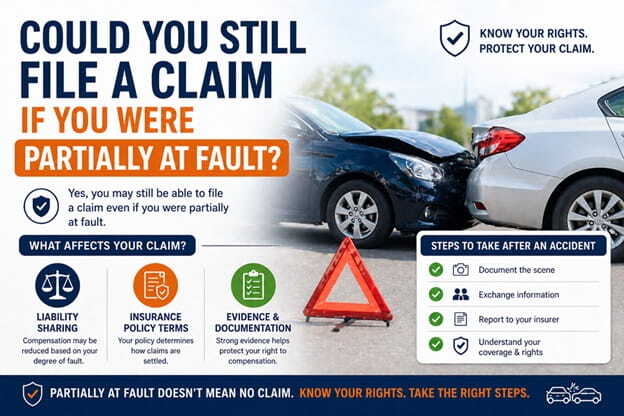
Featured Image Caption: Car Accident Claim Partially at Fault Scenario
Jump to read...
Finding yourself involved in an accident where you share some responsibility can feel overwhelming, especially when you’re dealing with injuries and wondering about your legal options. You might assume that bearing any fault automatically eliminates your right to compensation, but that’s not necessarily the case. The reality depends largely on where your accident happened and how that jurisdiction handles shared responsibility. Understanding these nuances can make a significant difference in protecting your rights and recovering the compensation you deserve. The legal framework surrounding partial fault is more nuanced than many people realize, and knowing what applies to your situation is the first step toward making informed decisions.
Understanding Comparative Negligence Systems
Most states across the country have adopted comparative negligence systems that recognize accidents rarely have just one responsible party. These systems allow you to recover damages even when you’ve contributed to the incident, though your compensation gets reduced by your share of the blame. Pure comparative negligence offers the most flexibility. Under this approach, you can pursue compensation regardless of your fault percentage.
Modified Comparative Negligence Rules
A number of states have taken a middle-ground approach by setting thresholds on when you can recover based on your level of responsibility. The fifty percent bar rule allows recovery only when you’re found to be fifty percent or less at fault. Cross that threshold, and you’re barred from collecting anything from other parties. Some states use a slightly different version called the fifty-one percent bar rule, which lets you recover as long as you’re not more responsible than everyone else combined.
Contributory Negligence Jurisdictions
A handful of states still maintain what many consider an unusually harsh rule called contributory negligence. Under this doctrine, even one percent of fault on your part completely eliminates your right to any compensation, regardless of how negligent the other party was. Virginia, Maryland, North Carolina, Alabama, and the District of Columbia continue applying this strict standard. If you’re ninety-nine percent blameless but a jury finds you contributed even minimally to your injuries, you walk away with nothing.
How Fault is Determined in Shared Responsibility Cases
Figuring out who bears what percentage of responsibility requires digging into every detail surrounding your accident. Police reports, witness accounts, scene photographs, surveillance footage, and expert analysis all contribute to piecing together what happened. You’ll need to prove the other party acted negligently and that their negligence directly caused your injuries, while they’ll work to demonstrate you also failed to exercise reasonable care. Insurance adjusters and attorneys examine everything from traffic violations to distracted behavior, safety regulation compliance, and whether everyone involved acted as a reasonably careful person would have under similar circumstances.
Factors That May Contribute to Shared Fault
Numerous actions or circumstances can lead to findings of partial responsibility in accident cases. Failing to wear a seatbelt or use required safety equipment might not have caused the collision, but it could have made your injuries worse. Texting while driving, adjusting your radio, or other distractions can contribute to fault even when the other driver committed a more serious violation. Running a red light, exceeding speed limits, or losing control of your vehicle are common scenarios where courts find shared responsibility.
Protecting Your Right to Compensation
Taking the right steps immediately after an accident where you might share some fault can significantly impact your recovery options. Getting medical attention promptly serves two purposes: addressing your health needs and creating documentation linking your injuries to the accident. Collecting evidence at the scene matters tremendously. Take photographs, get witness contact information, and make detailed notes about what happened before memories fade or evidence disappears. Be careful about what you say to insurance adjusters or other parties. While honesty matters, accepting blame before anyone has thoroughly investigated all the facts can hurt your case down the road.
When evaluating complex fault scenarios in vehicle collisions, professionals who need to navigate shared responsibility cases often work with a car accident attorney in Los Angeles to ensure their rights are protected under California’s pure comparative negligence system. Insurance companies frequently try to assign you more fault than the evidence supports, hoping to reduce what they’ll have to pay. Keep thorough records of everything: medical bills, lost wages, property damage, and how your injuries have affected your daily life. Each state sets time limits called statutes of limitations for filing claims, so acting promptly preserves your legal options.
Conclusion
Whether you can file a claim after being partially at fault hinges mainly on the negligence system governing where your accident occurred. Most jurisdictions allow recovery under comparative negligence frameworks, though your compensation decreases based on your share of responsibility. A few states still enforce contributory negligence rules that eliminate recovery entirely if you share even minimal fault. Learning how fault gets determined and taking steps to minimize your responsibility while documenting the other party’s negligence gives you the best chance at fair compensation. Even when you’ve made mistakes that contributed to an accident, you may still deserve substantial recovery that helps you heal and rebuild your life.






Leave a Reply