

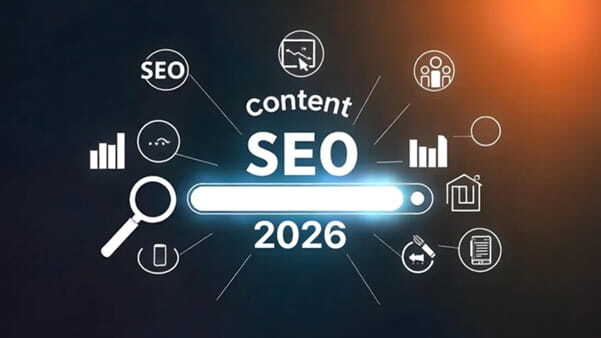
Featured Image Caption: AI SEO
Jump to read...
Let’s be real: the “10 blue links” era isn’t just fading; it’s basically a ghost. If you’re still trying to win by stuffing keywords into a generic 500-word blog post and praying for a click, you’re essentially shouting into a void. By 2026, the internet will have moved past simple information retrieval. We’ve entered the age of information synthesis.
As the future of AI search takes over, platforms like Google and Perplexity have stopped being just signposts that point people to your website. Instead, they’ve become active researchers and narrators that digest your content and serve it up to the user in a personalized, ready-to-use conversation. Instead, they act as researchers, editors, and narrators who consume your content and repackage it for the user in real-time.
For any scaling Digital Marketing Services, the challenge is no longer just “ranking”; the new hurdle is “citability.” If an AI model doesn’t trust your data enough to include it in a generated summary, you are effectively invisible to the modern consumer. This transition into AI SEO in 2026 requires a radical departure from old-school tactics. We are now in the age of Generative Engine Optimization (GEO), where the “search result” is often a paragraph of synthesized text that answers a query before a user even considers clicking a link.
The stakes have never been higher for brands trying to maintain a foothold in this new reality. This isn’t just a trend; it’s a structural decline in traditional traffic. According to the latest 2026 industry data, we have reached a critical tipping point: 93% of searches conducted in Google’s “AI Mode” are now zero-click, meaning users receive their full answer without ever visiting an external website. This massive evaporation of traditional click-through rates proves that to survive, businesses must adopt Smart Strategies for marketing that prioritize “Entity Authority” and “Information Gain.” It’s about proving to the machines and the humans behind them that you aren’t just another generic voice in the crowd, but a definitive, lived-experience expert in your niche.
The Brutal Reality of Generative Discovery
We’ve reached a point where Google’s AI Overviews and platforms like Perplexity don’t just summarize the web; they are the web for most users. This shift, which we now call AI SEO in 2026, focuses on how Large Language Models (LLMs) interpret your brand’s data.
Think of modern search engines as high-end digital concierges. They don’t want to give you a map of the city; they want to tell you exactly which restaurant fits your mood, your budget, and your dietary needs. If your content isn’t structured to be that specific answer, you simply don’t exist in the eyes of the AI. We are no longer writing for a static index; we are writing for an intelligence that values nuance over volume.
Why the 2024 Playbook Fails Now
- The Death of the “Fluff” Blog: AI can write generic 500-word posts in seconds. If your content looks like a basic summary, search engines treat it as noise.
- Context over Keywords: AI now understands “latent intent.” It knows that if someone asks about “growing a business,” they might actually be looking for “lead generation strategies” or “B2B scaling.”
- The Value of Information Gain: If you aren’t adding a new perspective or unique data to the conversation, the LLM has no reason to cite your website as a source.
Smart Strategies for Marketing in a Synthesized World
Winning in this environment takes more than just technical tweaks. Smart Strategies for marketing in 2026 are about building a “moat” of human expertise that an AI cannot simply hallucinate.
The “Information Gain” Requirement
If you are just repeating what’s already on Wikipedia or Top 10 lists, you are invisible. Search engines now look for fresh data, a contrarian opinion, or a unique case study.
The Strategy:
Every piece of content should include a “proprietary insight.” This could be a poll you ran, a mistake your team made, or a unique framework you developed. AI cannot scrape what hasn’t been written yet.
Radical Content Structuring
AI models are essentially data-hungry machines. To feed them, you need to make your content “citability-friendly.”
- Use H3s for Specificity: Instead of a generic heading like “Tips,” use “3 Ways to Reduce Churn in SaaS Marketing.”
- The “Summary First” Rule: Start every section with a bolded, one-sentence takeaway. This is what the AI will grab for its “snippet.”
- Schema is Non-Negotiable: Technical Schema markup is the bridge between your human prose and the AI’s data requirements.
The “Human-in-the-Loop” Edge
To stay under the radar of AI detectors and, more importantly, to keep human readers engaged, you have to write like a person who has actually done the work. Use “I” and “We.” Talk about the time a campaign failed and why. That level of vulnerability is something a bot can’t replicate, and it’s exactly what users are starving for in a world of synthetic text.
The New Role of the Digital Marketing Agency
The job description of a Digital Marketing Agency has fundamentally changed. We aren’t just “SEO providers” anymore; we are “Context Architects.” Our job is to manage how a brand is perceived across the entire AI training set.
In 2026, an agency’s value lies in:
- Sentiment Control: Monitoring how different LLMs (Claude, Gemini, GPT-5) talk about a client. If the AI thinks your brand is “reliable but expensive,” we must address that perception at the data source level.
- Omnichannel Presence: Ensuring the brand is mentioned in the places AI goes to “learn”; Reddit, niche forums, specialized journals, and high-authority podcasts.
- Answer Engine Optimization (AEO): Creating content specifically designed to be the “voice” response for smart assistants and chat interfaces.
Building a “Topical Moat”
One of the most effective strategies for marketing right now is “Semantic Clustering.” Instead of writing five random blogs, you build a massive, interconnected hub of knowledge. This is where you prove to the future of AI search that your site is the ultimate authority on a specific cluster.
For example, if you are a Digital Marketing Agency specializing in law firms, you shouldn’t just write about “SEO for lawyers.” You should have deep dives into “Legal Ethics in Digital Ads,” “Client Intake Automation,” and “Local Map Pack Strategies.” This creates a “Topical Moat.” When an AI looks at your site, it sees a concentrated density of expertise.
The “LLM Optimization Audit”: A 2026 Necessity
We’ve pioneered a new process called the LLM Audit. This isn’t your standard site crawl. We literally “interview” the world’s leading AI models to see how they describe our clients. If you ask a bot, “Who is the leader in industrial plumbing in Dubai?” and it doesn’t mention you, we have a “Source Gap.”
Bridging this gap requires seeding the internet with factual, high-authority mentions in datasets that these models prioritize. This is the “hidden” side of AI SEO in 2026. It’s about being present in the citations, the footnotes, and the training data where AI agents gather their “facts.”
Don’t Ignore the “Offline” Signals
Ironically, the best way to win at digital search in 2026 is to do things offline. Real-world events, speaking engagements, and physical networking create “digital ripples.”
When people go back to their computers and search for your specific name or brand, it sends a massive signal to the AI that you are a real-world “entity” worth recommending. AI doesn’t just look at links; it looks at “brand search volume” as a proxy for trust.
Conclusion
Adapting to AI SEO in 2026 isn’t a reason to panic; it’s actually your best shot at finally cutting through the digital noise. For too long, the internet has been drowned in “filler” content written specifically for algorithms. Ironically, those bots are now finally smart enough to ignore the fluff and look for content actually written for humans.
By doubling down on credible data, clear answers, and genuine storytelling, you’re making sure your brand doesn’t just get indexed; it gets noticed. The future of AI search belongs to the helpful: those who can provide the most value in the shortest amount of time. Whether you’re doing this in-house or partnering with an expert, the mission is clear: Be the authority that the AI can’t afford to ignore.

By Jomon Christian
I am Jomon Christian, Co-Founder and VP at C2C Media. I help brands translate their vision into effective marketing strategies, focusing on digital growth, content optimization, and data-driven campaigns. My mission is to create strategies that deliver real impact and lasting results.
Member since April, 2026
View all the articles of Jomon Christian.












Leave a Reply