

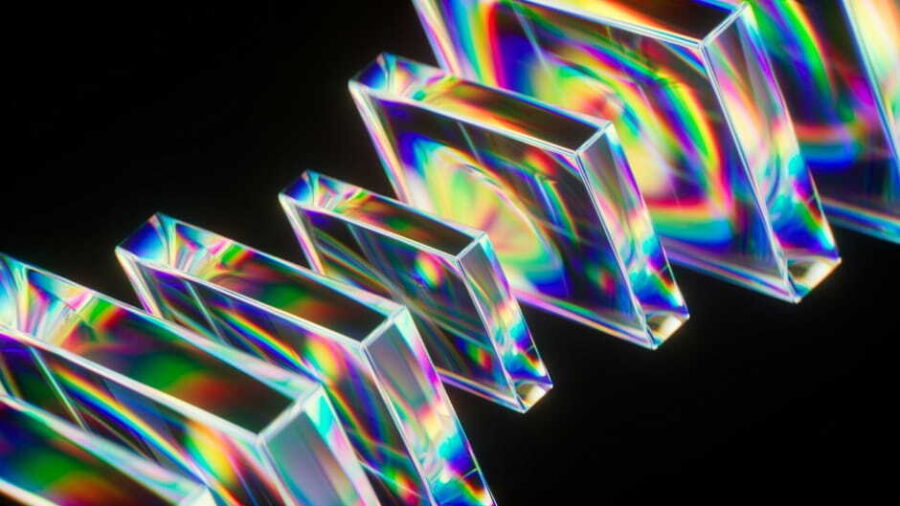
Featured Image Caption: A group of different colored objects on a black background.
Jump to read...
Physics can be one of the most abstract subjects in a student’s academic journey. Concepts like wavelengths, interference patterns, and the electromagnetic spectrum often live only on a whiteboard, disconnected from anything a student can actually see or touch.
This is where diffraction grating glasses have quietly become one of the most effective, low-cost teaching tools available to science educators. By turning invisible physical principles into a visible, wearable experience, these simple optical tools help students move from memorizing formulas to genuinely understanding how light behaves.
What Makes Diffraction Grating Glasses Different from a Regular Demo
Most physics demonstrations ask students to watch, whereas diffraction grating glasses ask them to participate.
Each lens contains thousands of microscopic parallel lines etched into the surface, so close together that they bend (or diffract) light into its component wavelengths. When a student looks at a light source through the lenses, ordinary white light instantly splits apart into a visible rainbow spectrum.
That instant transformation is what makes the tool so effective in a classroom setting. Instead of describing constructive and destructive interference in the abstract, students see the direct result of it, in real time, with their own eyes. The lesson stops being theoretical and starts being observable, which is often the turning point where physics clicks for students who otherwise struggle with the subject.
Teaching the Physics Behind the Rainbow
Diffraction grating glasses work well as more than a novelty moment at the start of a lesson. They can anchor an entire unit on the wave nature of light. Educators commonly use them to walk students through several connected concepts:
- Wavelength and color to show how different wavelengths of visible light correspond to the colors students see spread across the spectrum.
- Diffraction versus refraction to compare how a diffraction grating splits light differently than a prism. This gives students a clearer picture of two related but distinct optical principles.
- Line spacing and spectral resolution for using gratings with different line densities, such as 500 lines per millimeter versus 1,000 lines per millimeter. This demonstrates how finer spacing produces a sharper, more precise spectrum.
- Emission spectra and pairing the glasses with spectrum tubes or gas discharge lamps so students can observe how different elements produce their own unique spectral fingerprint, a concept that connects directly to chemistry and astronomy.
This last application is particularly valuable for advanced students. Once they understand that every element emits a distinct pattern of spectral lines, the conversation naturally extends into how astronomers use spectroscopy to determine the composition of distant stars. This connects a hands-on classroom activity to real scientific research.
Why Teachers Are Building Full Lessons Around This Tool
Beyond the individual glasses, many educators are expanding their approach to include diffraction grating slides and sheets, which can be projected onto a screen using an overhead or slide projector so an entire class can observe the same spectrum simultaneously. This shared viewing experience is useful for group discussion, allowing a teacher to point directly at specific bands of color while explaining the physics behind what students are seeing.
Some classrooms take the lesson further by combining diffraction gratings with colored film gels to explore additive and subtractive color theory. This bridges physics with art and design in a way that keeps a broader range of students engaged.
Because the materials are inexpensive and reusable across class periods and school years, they also make sense from a budget standpoint, particularly for departments looking to add hands-on components without a significant equipment investment.
Making Abstract Physics Tangible
The core value of this teaching method comes down to a simple idea: students retain more when they experience a concept rather than only hearing about it.
Diffraction grating glasses give physics teachers an efficient way to deliver that experience without complicated lab set-ups or expensive equipment. A single classroom set can support a lesson on wave behavior, a discussion on the electromagnetic spectrum, and a broader conversation about how spectroscopy is used in real scientific fields, all built around a tool students can hold in their own hands.
For educators looking to bring this kind of hands-on physics lesson into their classroom, a good place to start is exploring a dedicated collection of diffraction grating glasses and spectrum tools, which offers a range of formats suited to different grade levels and lesson plans.

By Andrew Lemieux
Meet Andrew Lemieux, our valuable contributor at InspiringMeMe.com. Andrew Lemieux is one of our top running authors/contributors and specializes in writing for travel, technology, literature and lifestyle articles among others.
Member since December, 2023
View all the articles of Andrew Lemieux.







Leave a Reply