

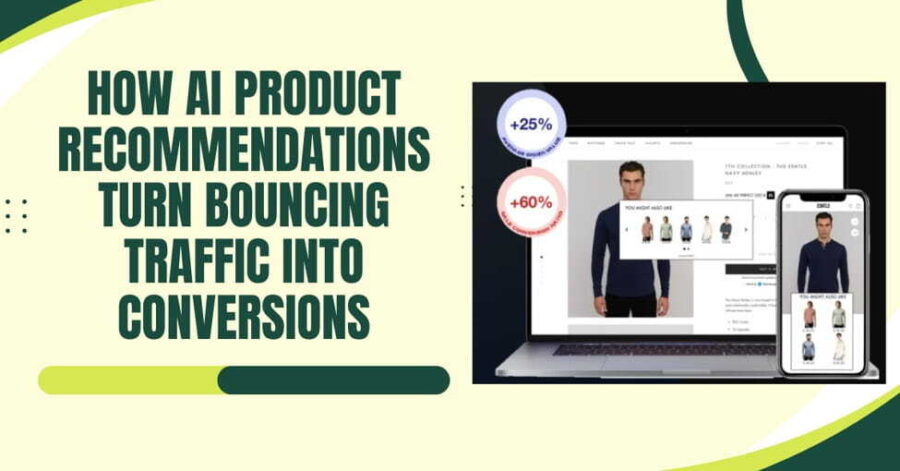
Featured Image Caption: Laptop and smartphone showing clothing website recommendations next to headline.
Jump to read...
Most online stores convert only about 2 or 3% of their visitors into buyers. Everyone else looks around and leaves, or fills a cart but never checks out. You can pour more money into ads to reclaim the lost value, but that just refills a leaky bucket. The wiser move would be to help the people already on your site find what they came for. And that is what AI product recommendations do. Instead of showing every visitor the same “customers also bought” row, they track each person’s actions during a visit and suggest items that fit that specific session.
Why “Customers Also Bought” Stopped Being Enough
For years, product suggestions ran on simple rules. The store looked at what most people bought and what was purchased together, then showed the same combinations to everyone. It worked, but up to a point.
Soon enough, declining conversion rates were traced back to the fact that two very different shoppers on the same product page were seeing the same suggestions. It did not matter where they came from, what they browsed earlier, or what was already in their cart, making the recommendations irrelevant.
A few other things that basic recommendations missed:
- No Real-Time Adaptation: They do not react in the moment. Someone who has clearly moved from laptops to laptop bags still gets shown chargers.
- Popularity Bias: They lean on bestsellers, so products that would suit one specific shopper rarely surface.
- No Intent Signal: They treat a casual browser and a ready-to-buy shopper the same way, even though those two need very different nudges.
- Cold-Start Blindness: They often go blank for first-time visitors and fall back to generic bestsellers, which is exactly when a good suggestion matters most.
- No Cross-Session Memory: They do not work differently for returning customers, ignoring weeks of browsing and past orders that should shape what shows up next.
What AI Product Recommendations Do Differently?
An AI recommendation engine reads the current visit in real-time. If a shopper switches from trainers to running socks, the recommendations switch too. Nobody had to program a different rule for that suggestion or combination in advance. Additionally, it learns from every session across the store, so the recommendations get sharper over time rather than staying frozen on a few bestselling combinations.
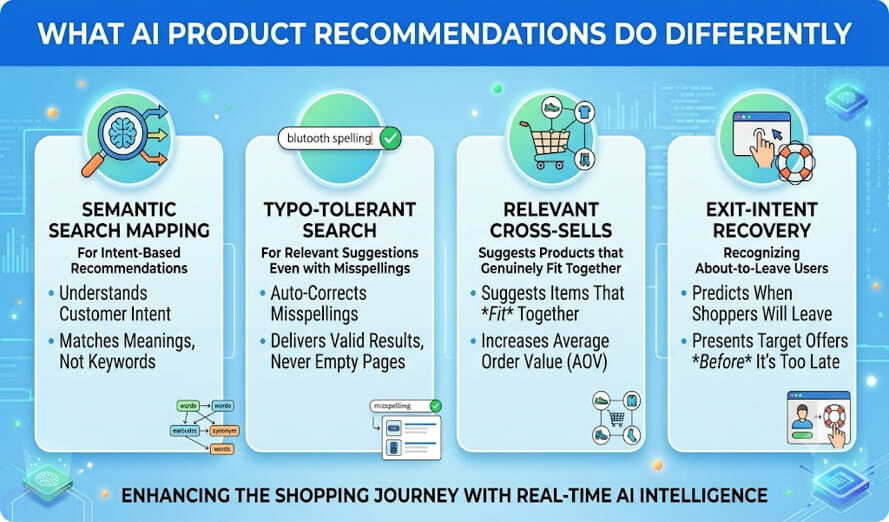
Key capabilities that differentiate AI-driven product recommendations from traditional e-commerce tools.
Semantic Search Mapping: For Intent-Based Recommendations
AI product recommendations work on meaning rather than words. They recognize that “wireless earbuds for running” and “sweatproof Bluetooth headphones” point at the same products, even without shared keywords. That connects shoppers to items a plain keyword match would have missed, which keeps them moving toward checkout instead of leaving to search elsewhere.
Typo-Tolerant Search: For Relevant Suggestions Even with Misspellings
Shoppers rarely type cleanly. They often misspell a product, drop a letter, or run two words together. A traditional search bar takes the query at face value and returns nothing. An AI product recommendation system inherently accounts for that. It compares the typed text against the product catalog, identifies the closest match, and corrects small spelling differences, so “blutooth speaker” resolves to “Bluetooth speaker”. The shopper lands on the right product rather than an empty results page that sends them elsewhere.
Relevant Cross-Sells: For Suggesting Products That Genuinely Fit Together
When a shopper adds size 10 trail running shoes to the cart, a well-tuned AI product recommendation engine responds with trail socks or insoles rather than an unrelated bestseller. The quality of these relevant combinations depends on how cleanly the product catalog is structured and on how it is used to train the underlying recommendation model. Done well, the order value rises modestly, and the experience improves at the same time, since the added items are ones the shopper was already inclined to buy.
Exit-Intent Recovery: For Recognizing About-to-Leave Users
Shoppers give clear signals before they abandon a page. The cursor drifts toward the close button, activity stalls for an extended pause, or attention shifts to another tab. Older recommendation systems answer all of these with the same generic approach, usually a blanket discount. An AI recommendation engine monitors these signals in real-time and scores how likely the visit is to end. Mouse speed and direction, idle time, and a switch away from the tab all feed that score. When it crosses a set threshold, the engine treats the session as at risk and acts before the shopper leaves.
It then offers something more relevant, such as a lower-priced alternative or a bundle offer. With cart abandonment averaging around 77.81%, recovering even a fraction of those potential visits can be significant.
How Does this Improve Conversion Rates?
A major part of improving conversions is finding the points where potential buyers drop out of the buying process and fixing them. And this is what an AI product recommendation engine does. Each capability that AI product recommendations add lines up with a concept that CRO (conversion rate optimization) teams already work with.
Here’s how AI product recommendations increase conversion rates:
- Real-time, session-aware suggestions keep shoppers browsing, which raises dwell time and the number of products viewed per visit.
- Typo-tolerant and semantic search cuts zero-result pages and lowers the bounce rate on search.
- Cross-sells that genuinely fit lift average order value (AOV) and attach rate.
- Exit-intent recovery reduces cart abandonment by acting before a session ends.
- Sharper relevance across the visit improves the conversion rate on the traffic you already have.
However, the extent of these gains depends on how well the AI product recommendation engine is trained and set up. Suggestions are only as good as the product data behind them, making catalog quality and accuracy critical to successful implementation. Because these are the same metrics conversion teams already track, AI recommendations tend to fold into that work rather than sit beside it.
Looking Ahead: The Future of AI Product Recommendations
The takeaway is simple. AI product recommendations transform eCommerce from a static, catalog-driven process into a dynamic, intuitive shopping experience that meets customers exactly where they are. They help the visitors you already have find and buy exactly what they came for. In addition to securing a purchase, they also create new cross-selling opportunities by recommending relevant, closely related products. In the coming years, you can expect these systems to become even more deeply predictive, using hyper-personalized omnichannel data and autonomous agents to anticipate shopper needs before they even type a search query.
By Ravi Kant
who is the Vice President of the eCommerce and Photo Editing Division at SunTec India. With over two decades of global experience, he spearheads large-scale digital commerce initiatives that drive operational excellence and measurable ROI for global businesses. His expertise spans eCommerce strategy, digital transformation, and data-driven performance optimization.
Member since October, 2026
View all the articles of Ravi Kant.














Leave a Reply